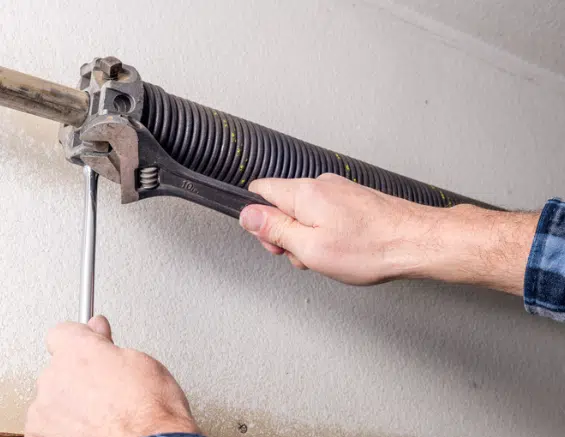
A cold Wisconsin morning. The car is running, the kids are ready for school, and the garage door won’t budge. Or worse, it slams shut without warning while someone is standing nearby. For many homeowners in Sussex, WI, this is not just a frustrating inconvenience. It is a genuine safety emergency.
Most people never think about their garage door spring until something goes wrong. But here is the truth: that spring is one of the hardest-working parts of the entire system. It carries the full weight of the door every single time it opens and closes. When it fails, everything else fails with it, and the consequences can be serious.
The garage door weighs anywhere from 150 to 400 pounds. The spring is what makes that weight manageable. Without it, that door becomes a heavy, unpredictable slab of metal that poses real danger to people, pets, vehicles, and property. That is why timely garage door spring replacement is not just a repair decision; it is a safety priority every homeowner should take seriously.
Can a Broken Garage Door Spring Really Be Dangerous?
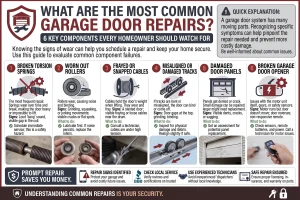
Yes, and it is more dangerous than most homeowners realize. Garage door springs are under an enormous amount of tension at all times. That tension is what allows a 300-pound door to feel light when the opener lifts it. When a spring snaps, that stored energy is released instantly, and the door loses all support.
The result can be a door that crashes down without warning, cables that snap outward at high speed, or a system that simply refuses to function safely. In Sussex, WI, where attached garages are common, and Wisconsin winters put extra stress on metal components, a broken spring is not something to ignore or delay repairing.
For a deeper look at what causes springs to fail and what repair options are available, check out this related read: Broken Garage Door Spring: Signs, Causes, and Repair Options.
7 Safety Risks a Broken Garage Door Spring Can Cause
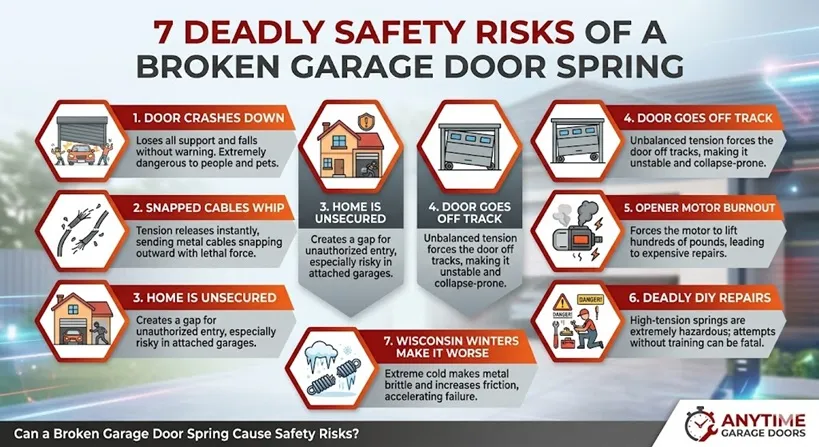
Risk 1: The Garage Door Can Crash Down Without Warning
This is the most immediate and dangerous risk. Garage door springs, whether torsion springs mounted above the door or extension springs running along the sides, are responsible for supporting the full weight of the door during operation. The moment a spring breaks, that support disappears.
A garage door that loses spring tension can drop suddenly and with significant force. Anyone standing underneath or nearby at that moment, including children, pets, or adults loading the car, is at serious risk of injury.
This is not a rare or unlikely scenario. It is the most common physical danger associated with a broken garage door spring, and it can happen the very first time the door is operated after the spring fails.
Safety tip: If the garage door has been making unusual noises, moving more slowly than normal, or behaving erratically, stop using it until a professional has inspected the springs.
Wondering how quickly this problem can be fixed once a technician arrives? Find out in How Long Does a Broken Garage Door Spring Take to Fix.
Risk 2: Snapped Spring Cables Can Whip and Cause Injury
Garage door springs do not work alone. They work together with a system of cables that help guide and support the door as it moves. When a torsion spring breaks, it releases a massive amount of stored energy in a fraction of a second.
That sudden release can cause the attached cables to snap or whip outward violently. Anyone standing nearby can be struck, resulting in cuts, bruises, or serious eye injuries. Even if no one is directly hit, the flying hardware can damage vehicles, walls, and other items stored in the garage.
This is one of the reasons why garage door spring repair is considered one of the most hazardous home repairs. It is not just the broken part that is dangerous. It is everything connected to it.
Safety tip: If a loud bang is heard coming from the garage, which is a common sound when a torsion spring snaps, keep everyone out of the garage until a technician has assessed the situation.
To understand exactly what happens the moment a spring gives out, this is a must-read: What Happens if a Broken Garage Door Spring Snaps.
Risk 3: A Broken Spring Leaves the Home Unsecured
A garage door that cannot close fully or stay closed is a security problem, not just a mechanical one. When the spring breaks, the door often loses the tension needed to seal shut properly. This creates a gap that is an open invitation for unauthorized entry.
In Sussex, WI, most homes have attached garages. That means an unsecured garage door is not just an outdoor problem. It is a direct access point into the living space of the home. A partially open garage door at night or while the family is away significantly increases the risk of a break-in.
Safety tip: If the spring breaks and the door cannot fully close, manually lock the door if it has a slide lock and secure the interior door between the garage and the house with a deadbolt. Call a local garage door professional as soon as possible rather than leaving the situation unresolved overnight.
Risk 4: The Garage Door Can Go Off Track
Garage door springs are responsible for maintaining even tension across both sides of the door. When a spring fails, that balance is thrown off. The door may begin to shift to one side as it moves, and if it shifts far enough, it can jump off its tracks entirely.
An off-track garage door is extremely dangerous to operate. Trying to force it open or closed, whether manually or with the automatic opener, can cause the door to buckle, collapse, or come down sideways. It can also cause significant damage to the door panels, the track system, and the opener itself.
Visible signs of an off-track door include uneven gaps along the sides, a door that looks crooked or tilted, or a door that makes grinding or scraping sounds while moving.
Safety tip: If the door looks uneven or sounds like it is scraping against something, stop using it immediately. An off-track garage door should only be reset by a trained technician.
Risk 5: A Broken Spring Puts Serious Strain on the Garage Door Opener
The garage door opener is designed to guide the door through its movement, not to carry its full weight. That job belongs to the spring. When the spring is broken, the opener is suddenly forced to do both jobs at once.
This puts the motor under extreme stress. In some cases, the opener will refuse to operate at all as a built-in protection measure. In other cases, the motor will struggle through, running harder than it was ever designed to handle. Over time, this kind of strain burns out the motor and shortens the lifespan of the opener significantly.
Replacing a garage door opener is considerably more expensive than replacing a spring. Catching a broken or worn spring early protects not just the spring itself but the entire system it supports.
Industry insight: Premature opener failure is often traced back to a spring that was worn down or broken and left unaddressed for too long. The opener takes the damage that the spring should have been absorbing.
Safety tip: If the opener sounds like it is straining, humming louder than usual, or moving the door more slowly than normal, have the spring tension checked right away.
Risk 6: DIY Repair Attempts Can Be Deadly
This point cannot be stated strongly enough. Garage door spring repair is widely recognized in the industry as one of the most dangerous DIY home repairs a person can attempt. The springs are under hundreds of pounds of tension at all times. That tension does not disappear when the spring breaks. It shifts, and it has to go somewhere.
Attempting to remove, adjust, or replace a garage door spring without proper training, tools, and experience puts the person doing the work at serious risk of catastrophic injury. The Door and Access Systems Manufacturers Association (DASMA) and consumer safety organizations consistently advise homeowners to leave spring repair to licensed professionals.
A spring that releases unexpectedly during an amateur repair attempt can cause broken bones, deep lacerations, facial injuries, and in extreme cases, fatalities. No amount of online tutorials or video guides changes the physical reality of what these springs are capable of.
Safety tip: When a garage door spring breaks, the safest and smartest move is to call a licensed garage door technician. This is one repair where the average cost of professional service is absolutely worth it compared to the risk of handling it without proper training.
Risk 7: Cold Wisconsin Winters Make Everything Worse
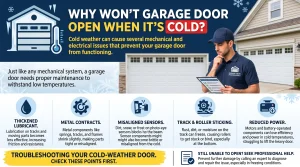
Sussex, WI, sits in Waukesha County, where temperatures regularly drop well below freezing from late November through February. That kind of cold has a direct effect on the metal components of a garage door system, especially the springs.
Metal contracts in cold temperatures. For springs that are already worn down or approaching the end of their lifespan, that contraction adds extra stress. This is why a large percentage of garage door spring failures in Wisconsin happen during the coldest months of the year. A spring that seemed fine in September may snap on a January morning when temperatures have dropped overnight.
Cold weather also causes the grease and lubrication on the springs to thicken, which adds friction and resistance. That extra strain accelerates wear on springs that are not regularly maintained.
Seasonal tip: Scheduling a professional garage door inspection every October or early November, before the harshest weather arrives, is one of the most effective ways Sussex homeowners can prevent a cold-weather spring failure.
How Do You Know a Garage Door Spring Is About to Break?
Catching a spring problem before it becomes a full failure is always the better outcome. Here are the warning signs that every homeowner should know:
- The garage door moves more slowly than it used to
- The door feels heavier when lifted manually
- There is a visible gap or separation in the torsion spring coil above the door
- The door opens unevenly, with one side higher than the other
- A loud bang comes from the garage, sometimes described as a firecracker sound
- The opener hums or strains, but the door does not move
- The door reverses before it fully opens or closes
- Squeaking, grinding, or scraping sounds during operation
Spring replacement is one of the more affordable garage door repairs available. Replacing both springs at the same time is always recommended, since if one fails, the other is not far behind.Any one of these signs is worth taking seriously. Multiple signs together mean a call to a professional should happen sooner rather than later.
5 Ways Sussex, WI Homeowners Can Prevent Spring Failures
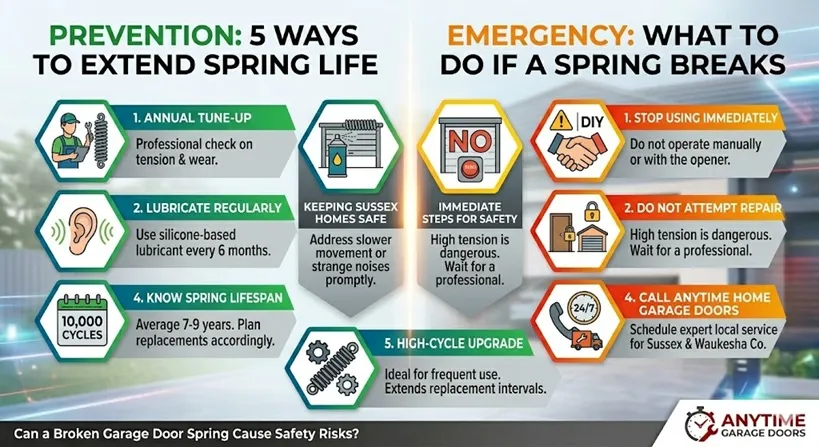
Prevention is always less expensive and less stressful than an emergency repair. Here are five practical steps that extend spring life and reduce the risk of unexpected failure.
- Schedule an annual garage door tune-up: A professional technician will check spring tension, lubricate moving parts, inspect cables, and flag anything that is wearing down before it becomes a problem. This one step alone dramatically extends the life of the entire system.
- Lubricate the springs every six months: Use a silicone-based lubricant or a product specifically designed for garage door components. Avoid WD-40, which is a water displacer, not a long-term lubricant. Proper lubrication reduces friction, slows wear, and helps the springs handle temperature changes more effectively.
- Do not ignore early warning signs: A slightly slower door or a faint squeaking sound might seem minor. But these are often the earliest signs of a spring that is losing tension or wearing thin. Addressing it early is almost always cheaper and safer than waiting until it breaks.
- Know the lifespan of the springs: Most standard garage door springs are rated for around 10,000 open-and-close cycles. For a household that uses the garage door four times a day, that works out to roughly seven to nine years. If the springs are in that age range, an inspection is a smart investment.
- Consider upgrading to high-cycle springs: High-cycle springs are rated for 25,000 cycles or more. For busy households or homes where the garage is used frequently, the upgrade is often worth the additional average cost. It significantly reduces how often the springs need to be replaced.
What Should Sussex, WI Homeowners Do If a Garage Door Spring Breaks?
Acting quickly and safely makes a big difference. Here is what to do if a spring breaks.
- Step 1: Stop using the door immediately: Do not try to open or close it manually or with the automatic opener. The system is compromised, and further use can make things worse or cause injury.
- Step 2: Do not attempt to fix it: As covered above, this is not a repair for homeowners to handle on their own. The risk of serious injury is too high.
- Step 3: Secure the home: Lock any manual locks on the garage door. Lock the interior door between the garage and the living space. If the garage door is stuck partially open, keep a close eye on the space until a technician arrives.
- Step 4: Call a local garage door professional in Sussex or the Waukesha County area: Look for a licensed, insured technician with experience in both torsion and extension spring systems. Local professionals are familiar with the specific demands of Wisconsin winters on garage door hardware.
- Step 5: Ask about spring options: A qualified technician can recommend whether standard or high-cycle springs are the better fit based on the door weight, usage frequency, and budget. This is a good opportunity to also ask about a full tune-up to ensure the rest of the system is in good shape.
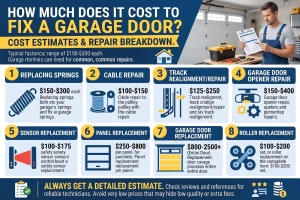
The average cost of a professional spring replacement is one of the more affordable garage door repairs available. It is significantly less expensive than replacing a burned-out opener, repairing structural door damage, or dealing with an injury.
Do Not Wait Until It Is Too Late
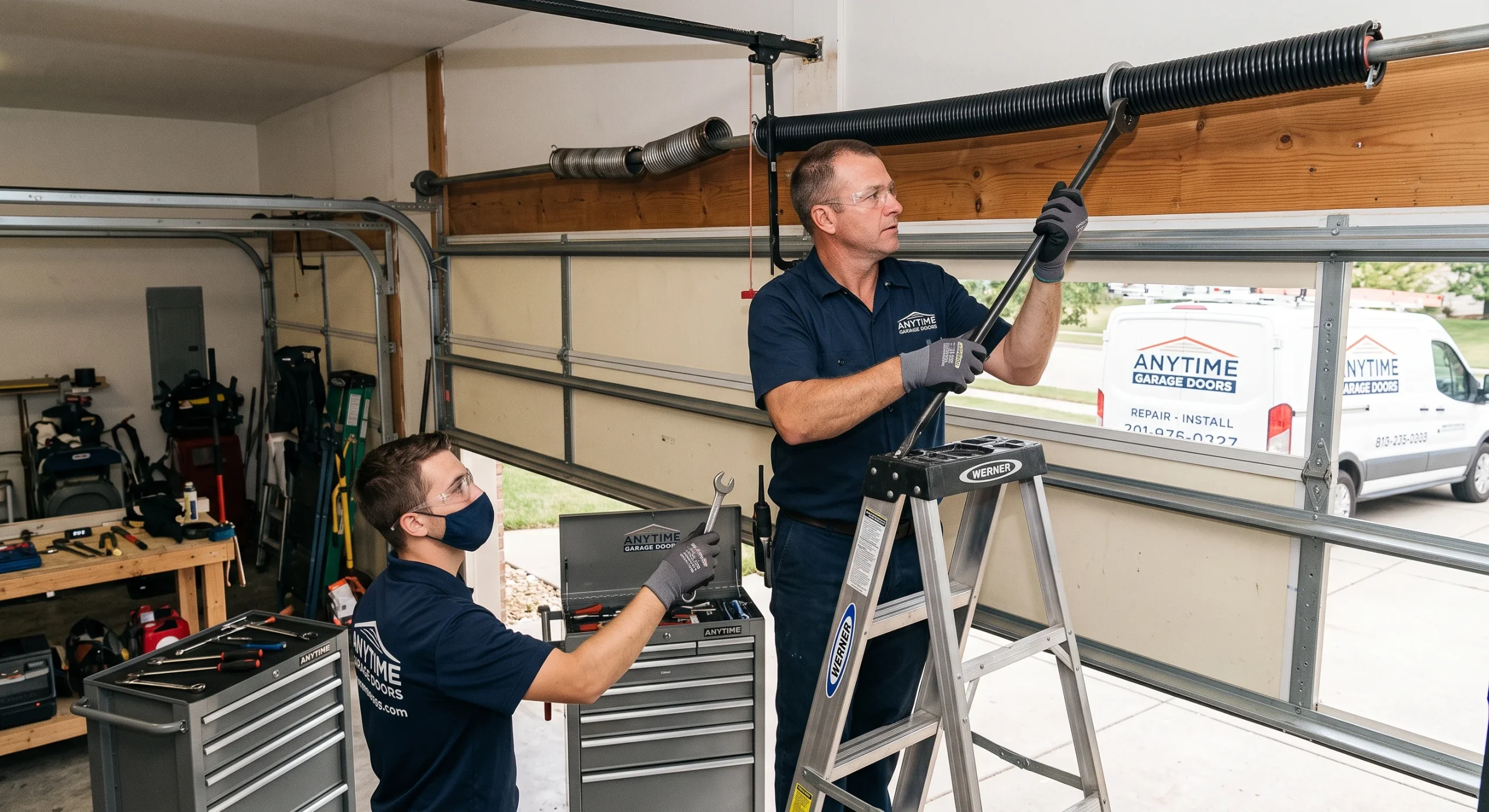
A broken garage door spring is not a problem to put off until the weekend. It is a safety issue that affects everyone in the home. From a door that can crash down without warning to a home that cannot be properly secured, the risks are real, and they escalate the longer the problem goes unaddressed.
For Sussex, WI homeowners, the combination of cold winters, frequent garage use, and attached garages makes spring maintenance more important, not less. Taking care of the springs now, whether through a scheduled inspection, regular lubrication, or addressing early warning signs, is the most effective way to keep the garage door system working safely for years to come.
When in doubt, reaching out to a trusted local professional for garage door spring repair is always the right call. The inspection alone can give peace of mind and potentially prevent a much more expensive and dangerous situation down the road.
Trust a Local Expert to Get the Job Done Right
That trusted local name in Sussex, and the greater Waukesha County area, is Anytime Garage Doors. With years of hands-on experience serving homeowners across the region, we bring the kind of expertise, reliability, and honest service that Sussex families count on when it matters most. From broken spring replacements to full system inspections, our team is equipped to handle it all quickly, safely, and professionally, so the garage door works the way it should every single time. Contact us today or give us a call to schedule a spring inspection before a small problem turns into a costly and dangerous one.