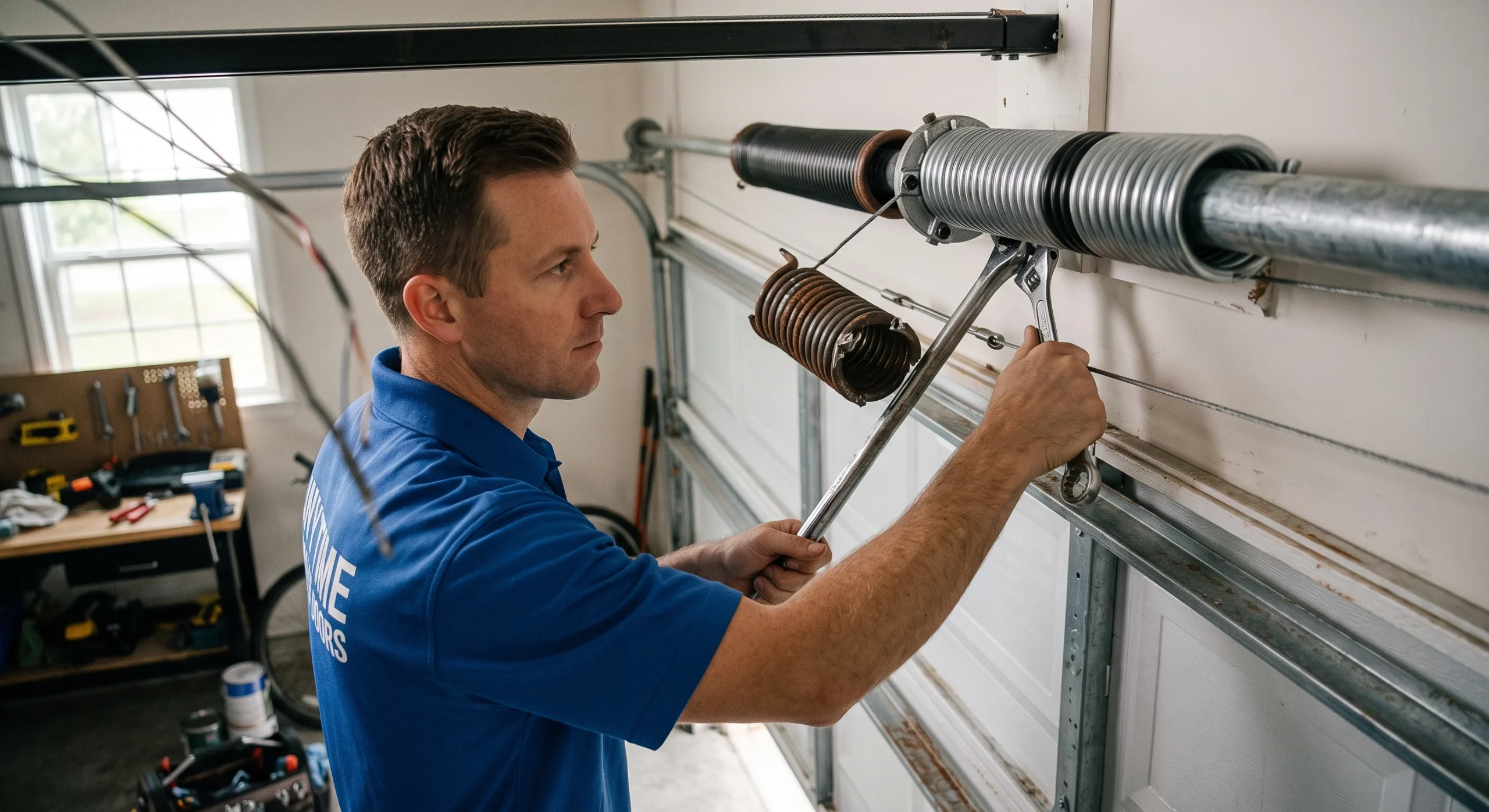
If you’ve ever been startled by a loud bang coming from your garage, you already know the panic that follows. One second, everything is fine, and the next, your garage door is sitting still, refusing to budge. That sound and that sudden stillness almost always point to one thing: a broken garage door spring.
For homeowners in Sussex, WI, this is one of the most common garage door problems, especially during the brutal freeze-thaw cycles that hit Waukesha County every year. Whether it ends with a garage door spring replacement or a full system inspection, understanding what just happened, what to check, and what to do next can save you from making the situation worse and potentially save you hundreds of dollars in additional repairs.
What Does a Garage Door Spring Actually Do?
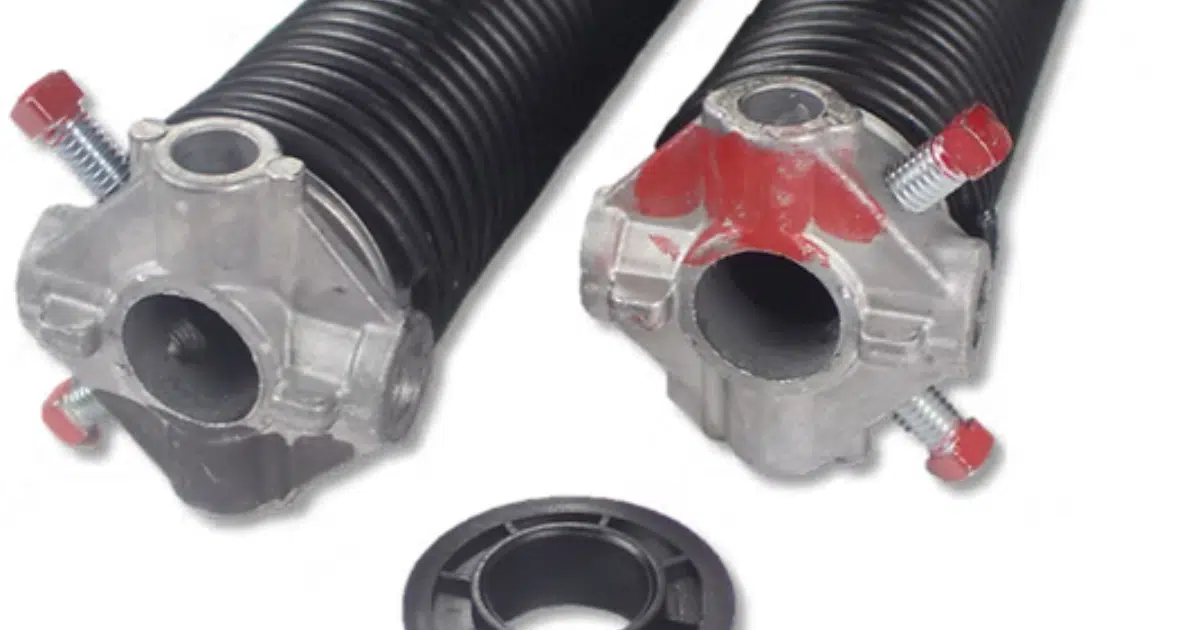
Before diving into the list, it helps to understand the job a spring is doing in the first place.
A garage door is heavy. Most residential doors weigh between 150 and 300 pounds. The spring system is what makes it possible for a small electric motor, or even just one hand, to lift that door with ease. Springs store mechanical energy and release it to counterbalance the weight of the door as it moves up and down.
There are two main types used in residential homes:
- Torsion Springs: Sit horizontally above the garage door opening. They twist and unwind to lift the door. These are the most common types found in Sussex area homes.
- Extension Springs: Run along the sides of the door tracks. They stretch and contract as the door moves.
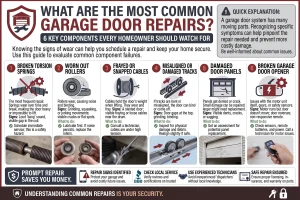
Both types work hard every single day. Most springs are rated for about 10,000 cycles, which translates to roughly 7 to 10 years of average use. Once they hit that limit, they don’t slowly stop working. They snap.
For a deeper look at how springs fail and what options are available when they do, the guide on Broken Garage Door Spring: Signs, Causes, and Repair Options covers everything homeowners need to know before making a decision.
9 Things That Happen When a Garage Door Spring Snaps
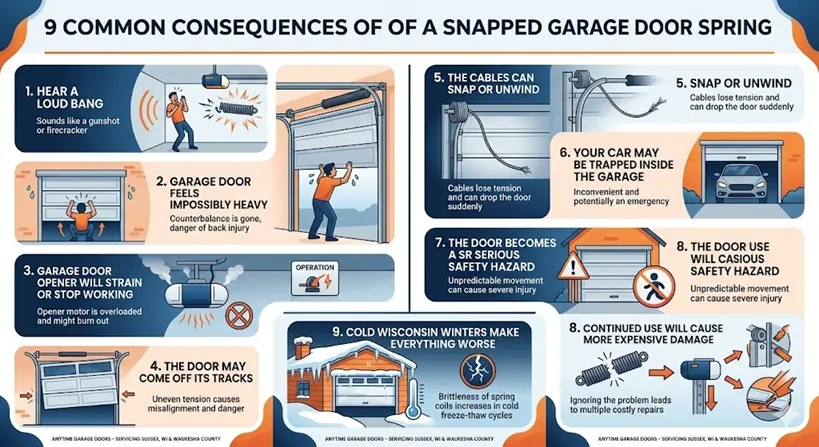
1. You’ll Hear a Loud Bang That Sounds Like a Gunshot
The first sign that a spring has broken is almost always the noise. Many Sussex homeowners describe it as a gunshot, a firecracker, or a car backfiring inside the garage. It’s startling, especially if it happens in the middle of the night.
That sound comes from the sudden release of all that stored tension. A torsion spring can hold an enormous amount of mechanical energy, and when the metal finally gives way, it releases all of that force in a split second.
The good news: That bang is just the spring. Nobody is breaking in. Nothing exploded. But it is a clear signal that something needs immediate attention.
Wondering how soon that attention needs to happen? The guide on How Long Does a Broken Garage Door Spring Take to Fix breaks down the entire repair timeline from start to finish.
2. The Garage Door Will Feel Impossibly Heavy
Once the spring is gone, so is the counterbalance. That 200-pound door is now just a 200-pound door with nothing helping it move.
Homeowners who try to manually lift the door after a spring snaps are often shocked at how heavy it feels. This is completely normal, but it is also a warning. Trying to force a door open without a working spring puts tremendous strain on your back, your hands, and, more importantly, the rest of the garage door system.
The safest move is to leave the door where it is until a professional can assess the situation.
The risks go beyond just a heavy door. Can a Broken Garage Door Spring Cause Safety Risks digs into exactly why a snapped spring is a hazard that should never be taken lightly.
3. The Garage Door Opener Will Strain or Stop Working
Garage door openers are designed to work alongside a properly functioning spring system. The motor assists the movement; it does not do all the heavy lifting.
When a spring snaps, the opener suddenly has to deal with the full weight of the door on its own. Many units will strain, move slowly, or stop completely. Some will trigger their built-in safety sensors and refuse to operate. Others, if forced repeatedly, can burn out the motor entirely.
Tip: If the spring is visibly broken, disconnect the automatic opener right away. There is usually a red emergency release cord hanging from the trolley. Pulling it disconnects the door from the opener, so the motor is no longer trying to work against that dead weight.
4. The Door May Come Off Its Tracks
A broken spring doesn’t just stop the door from moving. It can also throw off the entire balance of the system. When tension releases unevenly, the cables and drums that guide the door can shift out of alignment.
The result is a door that looks crooked. One side sits higher than the other. The panels may rub against the tracks. In more serious cases, the door can partially derail.
Warning: Do not try to force a door back onto its tracks without professional help. A misaligned or partially derailed door is under uneven stress and can come down suddenly and without warning.
5. The Cables Can Snap or Unwind
Garage door cables and springs work as a team. The cables are what physically pull the door up and guide it down. The springs are what give those cables the tension they need to do their job.
When a spring goes, the cables can go with it. They may unwind from the drum, go slack, or, in some cases, snap under the sudden shift in load. A snapped cable looks like a loose wire hanging near the sides of the door or lying on the garage floor.
This is a visual check that homeowners can safely do from a distance, without touching anything. If cables are visibly loose, frayed, or snapped, the repair scope has grown beyond just the spring.
Garage door cable repair in Sussex, WI, is a common follow-up to a broken spring, and catching it early prevents the door from dropping unexpectedly.
6. Your Car May Be Trapped Inside the Garage
This is the part that turns an inconvenience into a genuine emergency for a lot of Sussex homeowners, especially on a Monday morning in January.
With the spring broken and the opener disconnected, the door may not budge. Here is a safe way to manually open it using the emergency release:
- Locate the red emergency release cord hanging from the opener trolley
- Pull it straight down to disengage the door from the opener track
- Carefully lift the door by hand using both hands on the bottom panel
- Have someone assist if possible, given the door’s weight without spring support
- Once open, prop the door securely before driving out, and do not leave it unattended
Important: Only do this if absolutely necessary. A door with a broken spring is unstable and should be handled with extreme care. This is a temporary solution to get a vehicle out, not a workaround for everyday use.
7. The Door Becomes a Serious Safety Hazard
A garage door without a working spring is one of the most dangerous things in a residential home. The weight alone makes it unpredictable. Without the spring holding it in balance, a door can drop suddenly and with significant force.
The risk is real for children, pets, and anyone standing near or under the door. Vehicles parked in the opening are also at risk of damage if the door comes down unexpectedly.
The Door and Access Systems Manufacturers Association (DASMA), the leading industry authority on garage door safety standards, consistently lists broken springs as a top cause of garage door-related injuries. This is not a repair to put off.
The safest position for a door with a broken spring is fully closed and locked until a licensed garage door technician can complete the repair.
8. Continued Use Will Cause More Expensive Damage
One of the biggest mistakes Sussex homeowners make after a spring snaps is continuing to operate the door anyway, either manually or by forcing the opener to keep running.
Every additional cycle puts more stress on components that were not designed to carry that load. What starts as a spring repair can quickly turn into:
- A burned-out opener motor
- Bent or warped door tracks
- Damaged door panels from uneven movement
- Snapped cables requiring full cable replacement
Catching the problem right away and stopping the use of the door keeps the repair contained. Ignoring it, even for a day or two, can turn an average-cost spring replacement into a much larger bill covering multiple components.
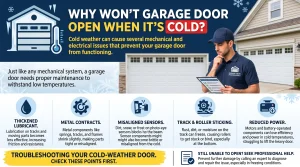
9. Cold Wisconsin Winters Make Everything Worse
This one is especially relevant for homeowners in Sussex, Menomonee Falls, Pewaukee, and the surrounding Waukesha County area.
Wisconsin winters are hard on garage door springs. Metal contracts in cold temperatures, which increases the brittleness of the spring coils. The freeze-thaw cycles that hit the area from November through March put repeated stress on springs, cables, and hardware that simply does not happen in warmer climates.
Many spring failures in the Sussex area happen on the coldest mornings of the year, precisely when you need your garage door to work the most. That’s not a coincidence. Cold metal under high tension is far more likely to snap than warm, lubricated metal operating in mild conditions.
This is why seasonal maintenance is especially important in this part of Wisconsin.
How to Prevent Your Garage Door Spring From Snapping
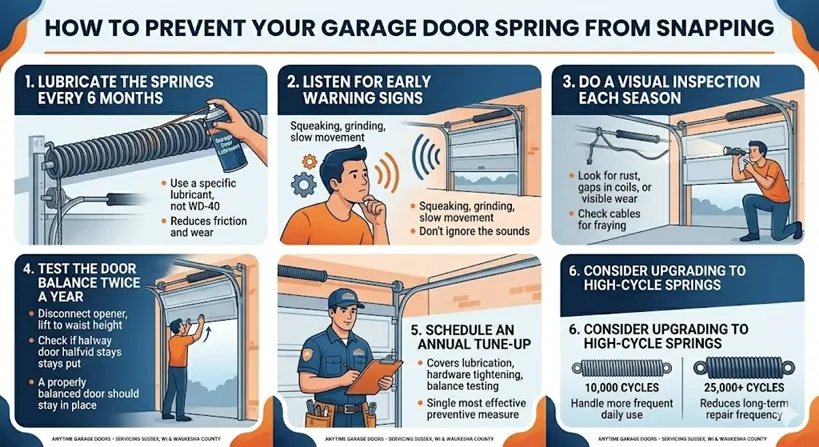
Prevention is always less expensive than repair. Here are practical steps Sussex homeowners can take to extend the life of their springs and catch problems before they become emergencies.
- Lubricate the springs every six months: Use a garage door-specific lubricant, not WD-40. Apply it to the coils of the torsion spring and along the cables. This reduces friction and slows wear, especially important before Wisconsin winters set in.
- Listen for early warning signs: Squeaking, grinding, or a door that moves more slowly than usual are all signs that the spring system is under stress. Do not ignore these sounds.
- Do a visual inspection each season: From a safe distance, look at the springs for rust, gaps in the coils, or visible wear. Check the cables for fraying or looseness. If anything looks off, call a professional before it becomes a bigger problem.
- Test the door balance twice a year: Disconnect the opener using the emergency release cord. Lift the door manually to about waist height and let go. A properly balanced door will stay in place. A door that falls or shoots upward has a spring tension problem that needs professional adjustment.
- Schedule an annual tune-up: A professional garage door inspection in Sussex, WI typically covers lubrication, hardware tightening, balance testing, and a spring assessment. This is the single most effective way to catch aging springs before they snap.
- Consider upgrading to high-cycle springs: Standard springs are rated for around 10,000 cycles. High-cycle springs can handle 25,000 to 50,000 cycles. For households that use the garage door multiple times a day, the upgrade pays for itself in reduced repair frequency.
Don’t Wait Until It Gets Worse
A snapped garage door spring is one of those problems that demands immediate attention. The loud bang, the heavy door, the trapped car, the safety risk, all of it comes down to one failing component that affects every other part of the system.
For homeowners in Sussex, WI, and throughout Waukesha County, the combination of aging hardware and harsh Wisconsin winters means this is not a matter of if a spring will eventually fail, but when. Knowing what to look for, what to avoid, and when to call a professional for garage door spring repair makes all the difference between a straightforward fix and a costly replacement of multiple components.
When a spring snaps, stop using the door, keep family and pets clear of the area, and contact a trusted local garage door professional in Sussex as soon as possible. The sooner it gets handled, the safer and more affordable the outcome will be.
Get It Fixed by a Local Expert You Can Trust
That trusted local professional is Anytime Garage Doors. Serving Sussex, WI, and the surrounding Waukesha County area, we have built a reputation for fast, reliable, and honest garage door repairs that homeowners can count on. From broken springs to full system inspections, our team shows up ready to get the job done right the first time, no shortcuts, no unnecessary upsells, just straightforward service from technicians who know garage doors inside and out. Ready to get your garage door back in safe working order? Contact us today or give us a call and get your spring replaced by a local Sussex expert you can trust. We are always ready to help.