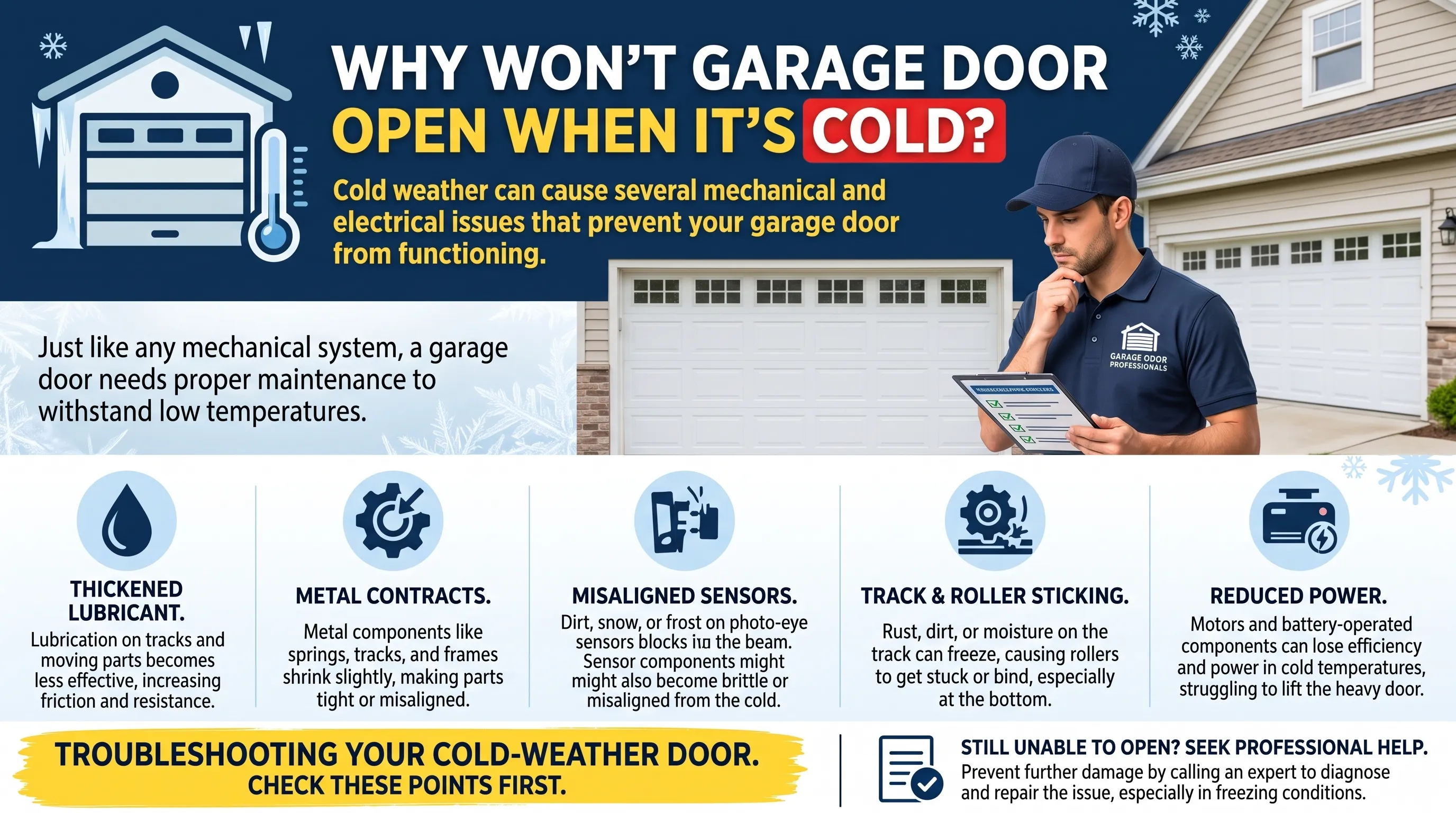
A garage door that will not open in cold weather is usually frozen to the slab, running on lubricant that has thickened into a paste, or fighting an opener whose force settings can no longer overcome the extra resistance. Cold also makes torsion springs brittle enough to snap, drains remote batteries, and puts snow, road salt, and low winter sun in front of the safety sensors. Most of these are not failures caused by the cold. They are marginal conditions that existed all fall and only became visible on the first morning below zero.
Key Takeaways
- The single most common winter cause is ice bonding the bottom seal to the concrete, not a mechanical failure.
- Never hold the opener button down on a door that will not move. The motor is not the strongest part of the system, and something else will give first.
- Cold weather does not break healthy springs. It finishes off springs that were already near the end of their cycle life.
- Grease-based lubricants thicken in deep cold. The wrong product applied in October causes problems in January.
- Remote range drops noticeably in freezing temperatures, which is a battery symptom rather than an opener fault.
- A pre-winter service visit prevents most of what is on this list, and costs far less than an emergency call at six in the morning.
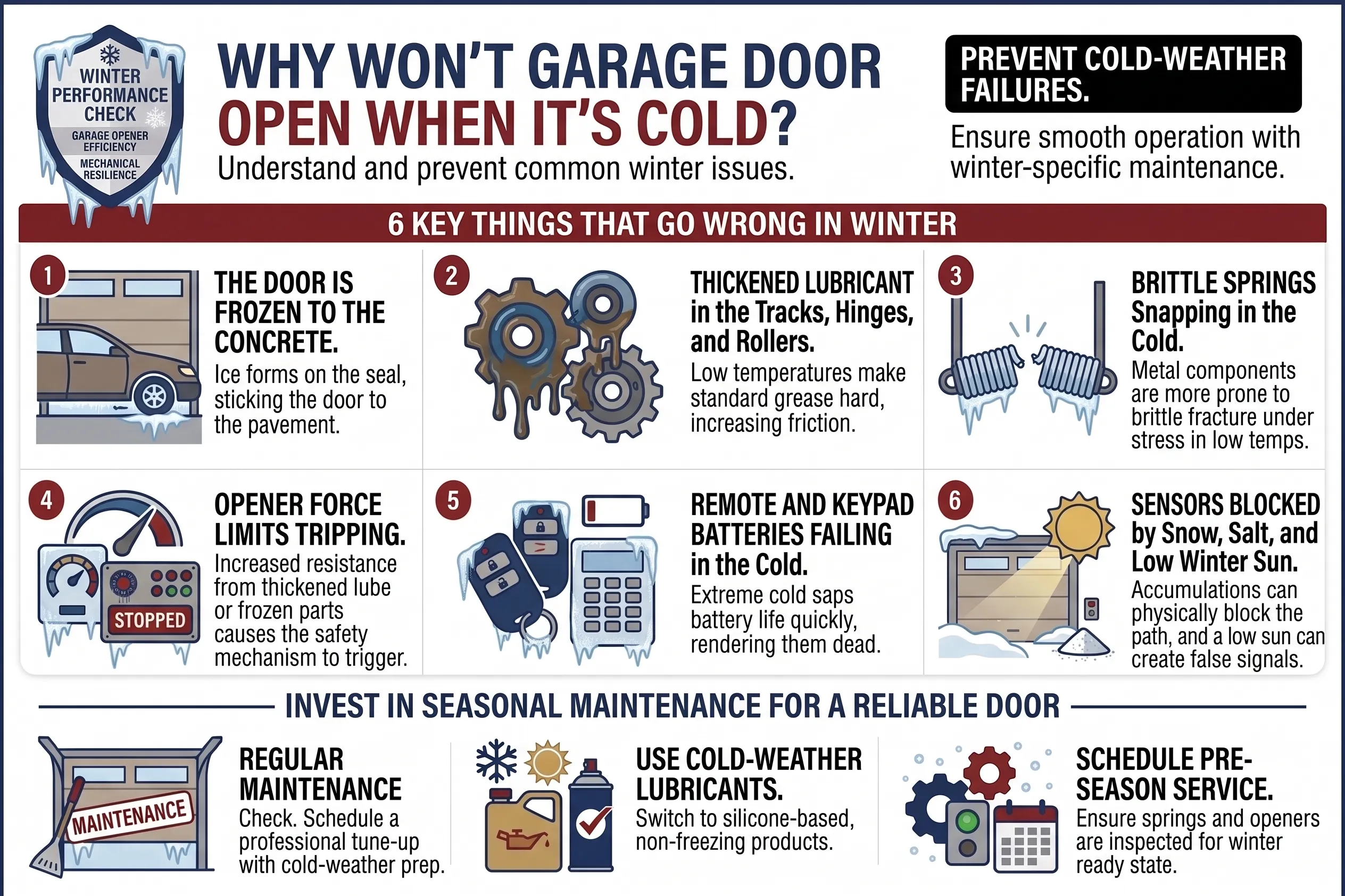
1. The Door Is Frozen to the Concrete
This is the most common winter call we run, and it is not a broken door. Meltwater, slush off the car, or rain that froze overnight seeps under the bottom seal, refreezes, and bonds the rubber to the slab. The opener then tries to lift a door that is physically stuck to the floor.
What is happening: The rubber astragal along the bottom edge is designed to compress and seal against the concrete. Once ice forms in that contact line, the bond can be surprisingly strong across the full width of the door.
What makes it worse: A hardened or cracked bottom seal lets more water underneath and holds ice more stubbornly. Seals get brittle after roughly five to seven years in this climate, faster with heavy salt exposure. A door that freezes down repeatedly usually has a seal at the end of its life rather than a bad-luck weather problem, and replacing it is one of the least expensive items on our residential garage door service menu.
What not to do: Do not hold the button down. Do not chip at the ice with a shovel or a metal scraper, which damages the seal and the concrete. Do not pour hot water, which refreezes and makes the next morning worse.
Call a pro if: The door has broken free but a panel is bent, the bottom seal is torn, or one side lifted while the other stayed stuck, which can pull the door out of square.
How to Tell If Your Garage Door Is Frozen Shut or Actually Broken
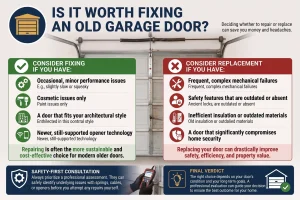
Listen to the opener. If the motor runs and strains but the door does not move at all, ice is the likely answer. If the motor runs and the door moves normally at the top but nothing happens at the bottom edge, that is also ice. If you hear a bang, a snap, or the motor running with no resistance at all, that is a mechanical failure and the cold is incidental. On an older door where this keeps happening, it is worth reading Is It Worth Fixing an Old Garage Door? 7 Questions That Decide It, because a repeatedly freezing door is often a door with a compromised bottom section.
2. Thickened Lubricant in the Tracks, Hinges, and Rollers
Grease that worked fine in October turns into paste at ten below. A door that opens slowly, groans, or stalls partway in cold weather is very often running on the wrong lubricant rather than failing hardware.
What is happening: Heavy grease and general-purpose oils increase in viscosity dramatically as temperature drops. On roller bearings and hinge pins, that turns a smooth-rolling assembly into one the opener has to force. Add old grease that has collected dust and grit, and the tracks themselves become a source of drag.
What makes it worse: Spraying lubricant into the tracks, which is a common and counterproductive habit. Tracks are a running surface, not a bearing surface. Lubricant there collects grit and creates exactly the sludge that binds in the cold. Our post on what causes garage door squeaking covers where lubricant does and does not belong, and garage door rails explains what the track is actually doing.
What the repair involves: Cleaning old buildup from the tracks and rollers, then applying a proper silicone or lithium-based garage door lubricant to hinges, bearings, and springs. It is quick work and it is standard on any garage door service visit.
Call a pro if: The door still drags after cleaning, or you can see a roller that is sliding rather than turning, which means the bearing has seized.
Why Garage Door Grease Stiffens in Freezing Weather
Viscosity rises as temperature falls, and general-purpose greases were never formulated for a Wisconsin January. Silicone-based products hold their properties far better in deep cold, which is why they are the trade standard here. If the last person to service your door used whatever was on the shelf in the garage, winter is when you find out.
3. Brittle Springs Snapping in the Cold
Cold weather does not break healthy springs. It finishes off springs that were already near the end of their service life. That distinction matters, because homeowners often assume the winter caused the failure and that a replacement will simply fail again next year.
What is happening: Steel loses ductility as temperature drops. A torsion spring already carrying micro-fatigue from thousands of cycles becomes measurably more likely to fracture under the same load. This is why spring calls cluster hard around the first serious cold snap of the season.
What it looks like: A loud bang from the garage, often overnight. In the morning the door will not lift, or lifts a few inches and stops. You will usually see a visible gap of an inch or two in the coil above the door.
What the repair involves: Matching a replacement to the door’s actual weight by wire gauge, inside diameter, and length, then replacing both springs together on a two-spring system. Details are in our guides on changing garage door springs and on whether a broken garage door spring creates safety risks. Cables take the same abuse and are worth inspecting at the same time, which our post on signs you need to replace garage door cables covers.
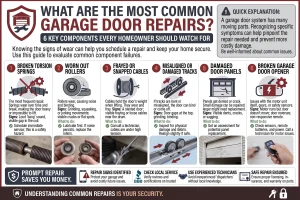
Call a pro if: Always. A wound torsion spring stores enough energy to cause serious injury, and this is not a repair with a safe homeowner version. Broken springs are the most common call in the trade generally, not just in winter, as our guide to What Are the Most Common Garage Door Repairs? 10 Jobs Homeowners Call For Most lays out.
Do Garage Door Springs Break More Often in Winter?
Yes, noticeably, and the pattern is consistent enough that we staff for it. If your springs are past seven years and the door has felt heavy or slow through the fall, having them looked at before December is one of the few genuinely preventive moves available. Be cautious of anyone who responds to a broken spring by pitching a full door replacement on the spot. Clopay’s homeowner guide on how to avoid garage door scams describes that exact pressure pattern, and a broken spring on a sound door is a repair.
4. Opener Force Limits Tripping
A door that starts to open, moves a few inches, then stops and reverses is usually hitting the opener’s force limit rather than jamming. The opener is doing what it is designed to do.
What is happening: Every opener has travel and force settings that tell it how much resistance is normal. When cold stiffens the door, thickens the lubricant, and adds a little ice drag, the resistance exceeds that threshold. The opener reads it as an obstruction and stops, which is the safety system functioning correctly.
What makes it worse: A door that is already out of balance. If the springs are no longer carrying the door’s weight properly, the opener is making up the difference on every cycle, and it has no headroom left when winter adds resistance.
What the repair involves: Finding and fixing the underlying drag first, then resetting travel and force limits for the actual conditions. Our post on adjusting a garage door opener explains the settings, and if the unit is old enough that this keeps recurring, our garage door opener page and our overview of overhead door openers cover current options with better cold-weather performance and battery backup.
Call a pro if: The force settings need increasing to make the door work. Turning the force up to overcome a real problem defeats the safety system and hides the underlying fault until something more expensive breaks.
Why Your Garage Door Opens a Few Inches and Stops in Cold Weather
That behavior is a diagnosis, not a mystery. The opener met more resistance than it expected and shut down. The right response is to find what is adding the resistance, ice, drag, or a failing spring, rather than to force the door through it.
5. Remote and Keypad Batteries Failing in the Cold
Battery output drops in freezing temperatures, which is why a remote that worked from the end of the driveway in October works from ten feet in January. Wall-mounted keypads suffer worst, because they live outside.
What is happening: The chemistry in a coin cell or alkaline battery slows as it gets colder, reducing available voltage. A battery with plenty of life left at room temperature can fall below the threshold needed to transmit at subzero temperatures, then recover during the day.
What makes it worse: Moisture in an outdoor keypad housing, which freezes and can corrode contacts. Also worth knowing: LED shop lights are a common source of radio interference that shortens remote range year round, and homeowners often blame the cold for a problem that started when they upgraded the garage lighting.
What the repair involves: Fresh batteries first, then checking the antenna wire hanging from the opener, then identifying interference sources. Our post on overhead door remotes covers programming and range troubleshooting.
Call a pro if: The wall button works and no remote does after fresh batteries and reprogramming. That points to the receiver rather than the controls.
Why Your Garage Door Remote Stops Working in Winter
It is almost always the battery, and the tell is that it improves during the warmest part of the day and gets worse overnight. A remote that fails consistently regardless of temperature is a different problem.
6. Sensors Blocked by Snow, Salt, and Low Winter Sun
Winter attacks the safety sensors from three directions at once, which is why the door closes fine in July and refuses in January. Snow piles in front of the photo eyes, road salt films the lenses, and the low winter sun angle can wash out the beam entirely.
What is happening: The two sensors near the floor must maintain an unbroken beam. Snow tracked in off the car, a snowblower parked in the beam path, or salt spray from the driveway all interrupt it. The sun issue surprises people: in December and January, the sun sits low enough to shine directly into a sensor lens through an open door and overwhelm the receiver.
What makes it worse: Frost heave and shifting concrete can move sensor brackets slightly out of alignment over a winter. So can bumping them with a shovel.
What the repair involves: Cleaning both lenses, checking the indicator LEDs, realigning brackets, and inspecting the wire run for staple damage. Our posts on what a yellow garage door sensor light means and testing a garage door sensor with a yellow light walk through the indicators, and our best garage door sensor roundup covers replacement units.
Call a pro if: The lights stay off or flicker after cleaning, or the door reverses on a clearly empty opening.
Never Bypass Garage Door Sensors to Force the Door Closed
This comes up every winter and the answer is always no. Taping the sensors together or wiring around them removes the mechanism that stops a closing door from crushing whatever is underneath it. Federal safety requirements have mandated reversing systems on residential openers since 1993, and the International Door Association has built much of its safety education around this exact component. If the sensors will not clear, the door waits.
Winter Symptoms and What They Usually Mean
What you see | Most likely cause | Urgency |
Motor runs, door does not move at all | Frozen to the slab | Wait for a thaw or call, do not force it |
Door opens slowly or groans | Thickened lubricant, dragging rollers | Schedule service |
Loud bang, then the door will not lift | Broken torsion spring | Call now |
Door opens a few inches, then reverses | Opener force limit tripped | Same day, do not increase force |
Remote works only up close | Cold-drained battery | Replace battery, then call if unchanged |
Door will not close, reverses every time | Sensors blocked, dirty, or sun-washed | Clean lenses, then call |
Door stuck open overnight | Any of the above, home is unsecured | Call now |
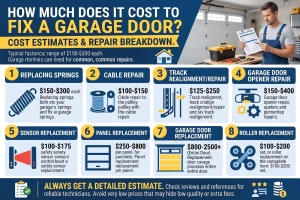
One note on winter pricing. Demand spikes during cold snaps and after-hours calls carry a premium at every reputable company, which makes this the season when high-pressure pitches show up most. The industry’s garage door repair scam awareness resources are worth a look before you book anyone in an emergency, and the full picture of what drives repair pricing is in How Much Does It Cost to Fix a Garage Door? 9 Things That Change the Price.
What to Do Before Winter Instead
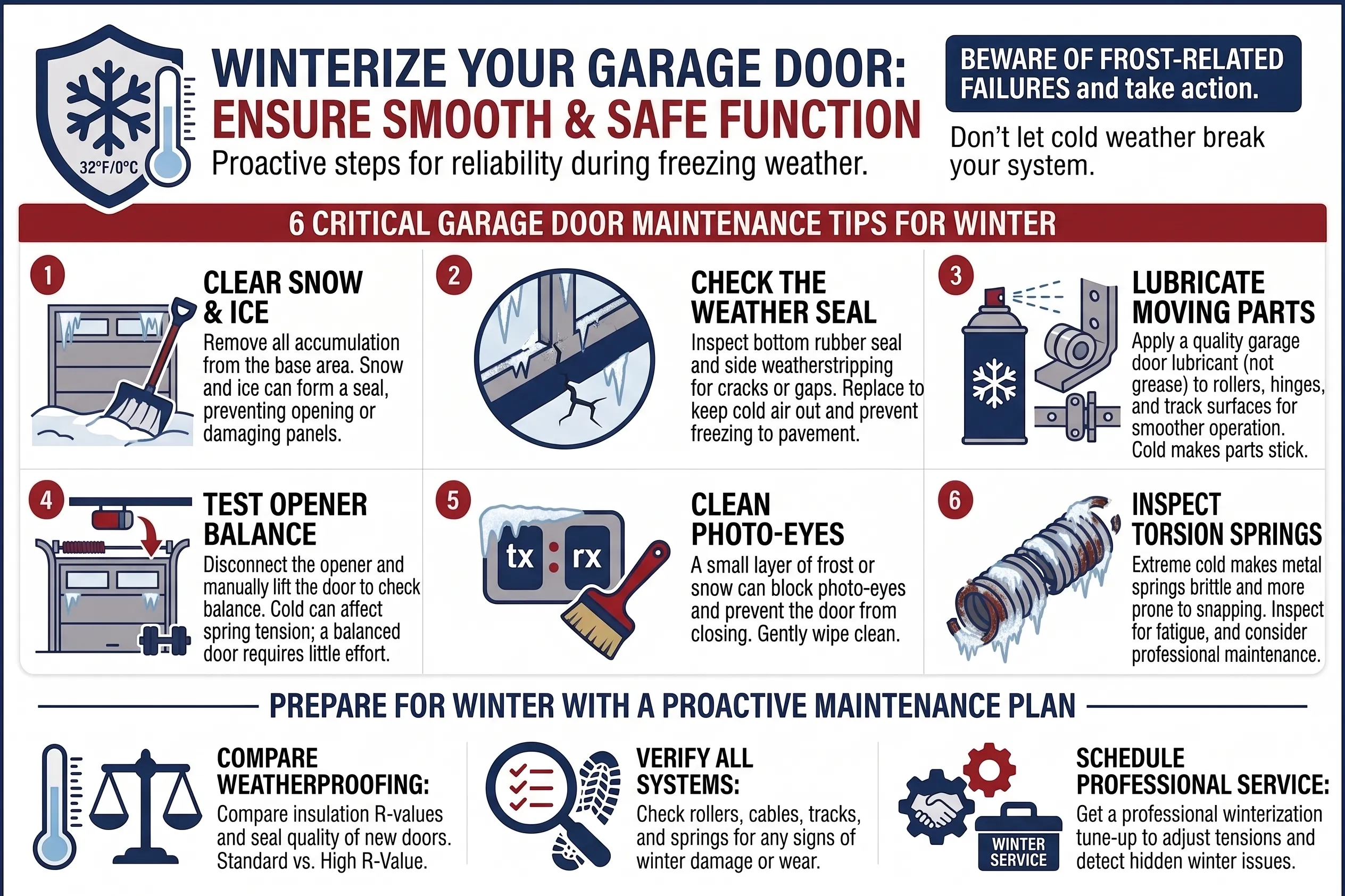
Almost everything above is preventable in a single autumn visit. Clean and inspect the tracks, replace worn rollers, switch to a cold-rated silicone lubricant, check spring balance and cycle age, replace a hardened bottom seal, and reset travel and force limits before the temperature drops rather than after something fails.
Keeping the slab clear helps too. Sweeping snow and slush away from the bottom edge before it melts and refreezes prevents most freeze-downs outright, and a small amount of attention to drainage at the apron does more than any product you can spray on the seal.
The same logic applies to businesses, where a dock door that will not open on a January morning stops the operation. Our commercial overhead door work runs on the same pre-winter schedule for exactly that reason, and our post on why immediate commercial door repair matters covers the downtime side. For homeowners, our overview of professional garage door service in Sussex describes what a seasonal visit includes.
The Short Version
A garage door that will not open in the cold is usually stuck rather than broken. Ice at the bottom seal and thickened lubricant account for most of these calls, and both are preventable. The genuinely broken cases, snapped springs above all, are almost always doors that were already worn and simply gave out on the coldest morning of the year.
The one habit worth changing is the instinct to hold the button down. The opener is not the strongest component in the system. When you force it, something else absorbs that load, and a frozen seal turns into a bent panel, a stripped gear, or a door pulled off its track.
If your door is stuck, Anytime Garage Doors runs winter calls across Sussex and the surrounding Waukesha and Milwaukee communities, and we will tell you on the phone whether it is worth an emergency visit or whether it can safely wait for morning. Schedule your service and we will get you moving again.