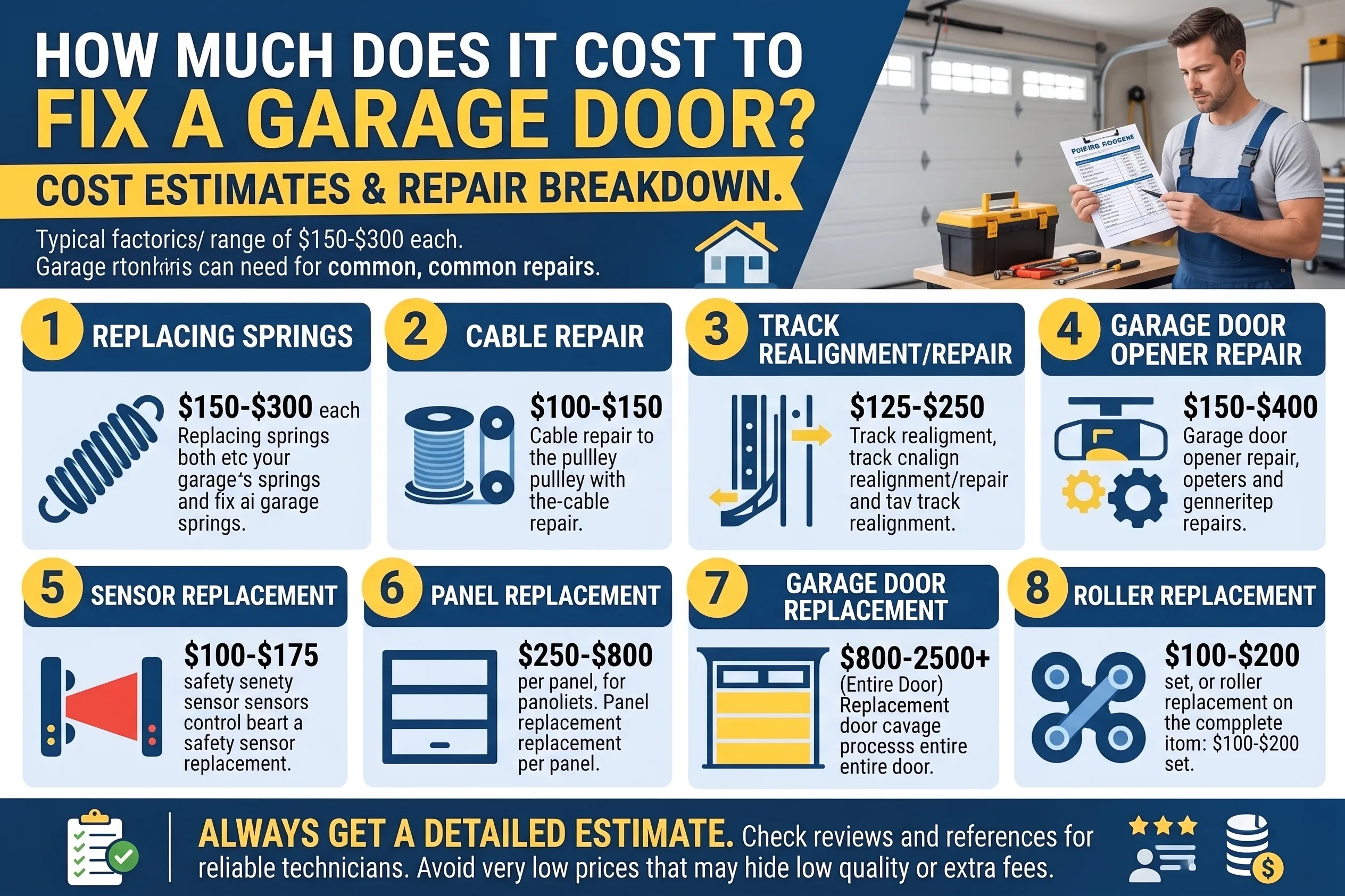
Garage door repair costs are driven almost entirely by which component failed. Sensor alignment, a bottom seal, or a remote sits at the low end of the range. Spring and cable replacement sits in the middle. A full opener replacement sits at the high end, because you are buying hardware rather than just labor. On top of the part itself, six other things move the number: door size and weight, door material, the age of the door and whether parts are still made, whether you call during business hours or at midnight, whether it is a residential or commercial door, and what the company includes for diagnostics and warranty.
Key Takeaways
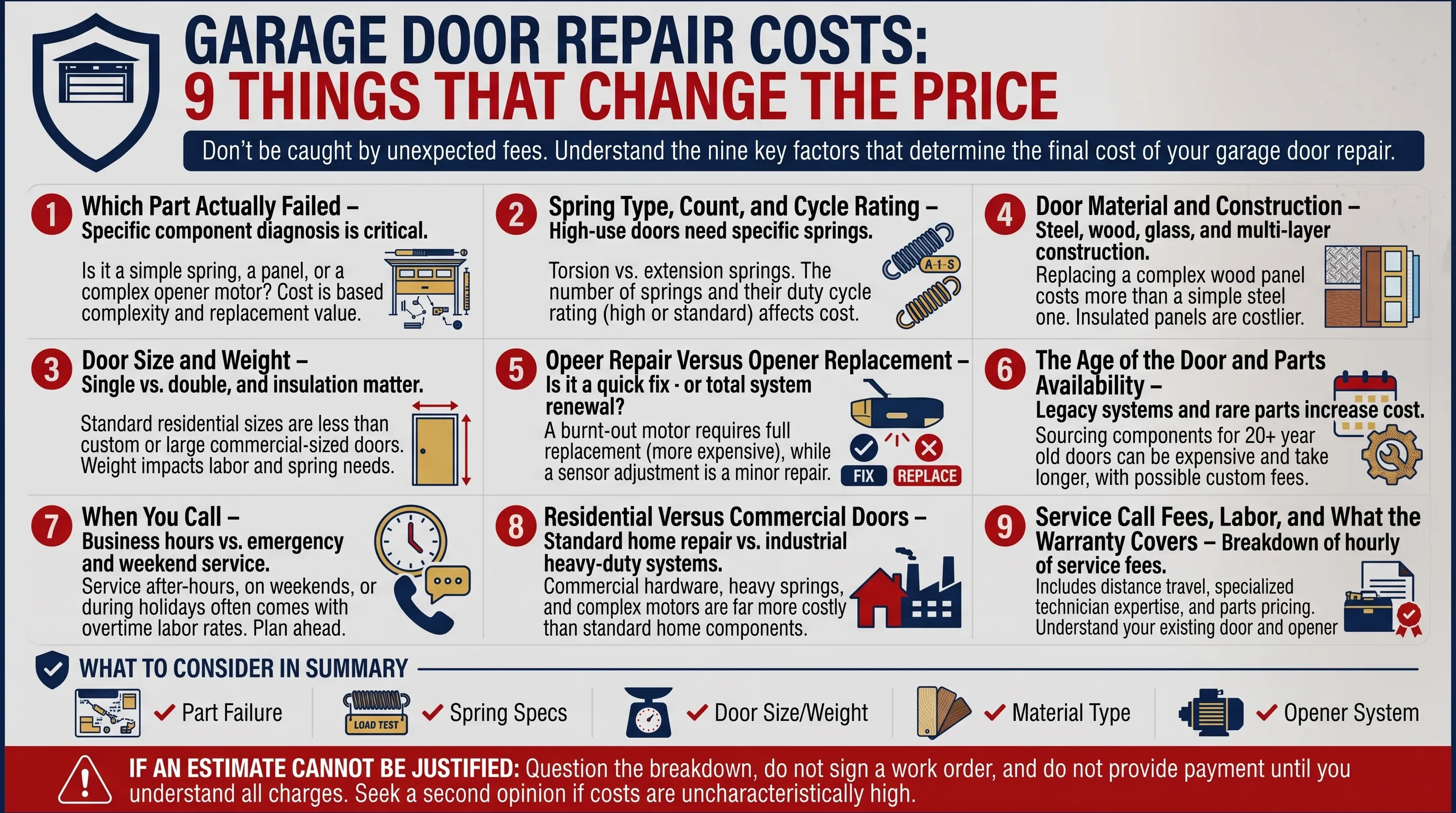
- The failed part sets the price band. Everything else adjusts within that band.
- A double door costs more to repair than a single door on the same job, because the springs, cables, and hardware are all rated heavier.
- Emergency, after-hours, weekend, and holiday calls carry a premium at essentially every reputable company.
- Insulated, wood, and custom doors cost more to repair than standard steel, mostly on parts and lead time.
- The cheapest quote is not automatically the best value. Ask what warranty covers the part and the labor, because a spring with a low cycle rating is cheap now and expensive in three years.
- Get the diagnosis and the price before work starts, in writing or over the phone, every time.
1. Which Part Actually Failed
This is the single biggest factor, and it is why nobody can quote you accurately over the phone from “my garage door is broken.” The same symptom can point to a twenty-minute adjustment or a full hardware replacement.
Roughly how the common repairs stack up against each other, from least to most expensive: safety sensor alignment, weather seal replacement, remote or keypad replacement, roller replacement, cable replacement, torsion spring replacement, panel replacement, opener replacement.
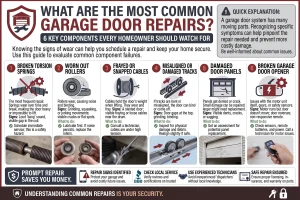
That ordering matters more than any specific number, because it tells you whether a quote is in the right neighborhood. If you were told the door reverses because the sensors are misaligned, and the quote lands where a spring job should be, something is off. Our overview of What Are the Most Common Garage Door Repairs? 10 Jobs Homeowners Call For Most walks through each of these jobs and what the work involves, which is worth reading before you compare quotes.
Why the Same Garage Door Symptom Gets Two Different Quotes
A door that will not close could be a dirty sensor lens or a failed logic board. A door that will not open could be a dead remote battery or a snapped spring. Until a technician has eyes on it, any quote is a guess. Companies that give firm prices sight-unseen are either padding for the worst case or planning to revise the number once they arrive.
2. Spring Type, Count, and Cycle Rating
Spring replacement is the most common mid-range repair, and the price swings on three things: torsion versus extension, one spring or two, and the cycle rating you choose.
Torsion springs mount on a bar above the door and cost more than the older extension springs that run along the side tracks, but they last longer and fail more safely. Most modern doors use torsion. A two-spring system costs more than a single-spring system, and both springs should be replaced together, since they wear at the same rate.
The variable most homeowners never hear about is cycle rating. A standard residential spring is built for roughly seven to ten thousand open-and-close cycles. High-cycle springs, typically rated at twice that or more, cost more upfront and last substantially longer. For a household running the door four or more times a day, the upgrade usually pays for itself. Our post on how long a broken garage door spring takes to fix covers the labor side, and what changing garage door torsion springs involves explains why this is not a homeowner job.
What You Should Ask Before Paying for Spring Replacement
Ask for the cycle rating and the wire gauge, and ask whether both springs are being replaced. A quote that seems unusually low often means a standard-cycle spring where the door needs high-cycle, or one spring replaced where two were needed. The International Door Association has pushed the trade toward this kind of transparency for exactly this reason.
3. Door Size and Weight
A double door costs more to repair than a single door on the same job, because every load-bearing part on it is rated heavier. Springs, cables, drums, and rollers all scale with the weight they carry.
A standard single door runs roughly eight to nine feet wide. A double runs sixteen to eighteen. The double is not simply twice the door, it is a heavier assembly that needs stronger hardware, and on some jobs it needs two technicians instead of one. Taller doors add cost as well, since eight-foot-high openings need longer tracks and different spring specs than the standard seven-foot.
If you are not sure what you have, our guide on how wide a single garage door is covers standard sizing, and overhead door sizes breaks down the common configurations around Sussex. Sizing also sets the baseline for anything on our residential garage door service menu.
Does a Two-Car Garage Door Cost More to Repair?
Yes, on nearly every repair type, and the gap widens on anything spring or cable related. On repairs where the part is not weight-dependent, a sensor, a remote, a bottom seal, door size makes almost no difference. That is a useful sanity check: if a quote for a small job scales with your door size, ask why.
4. Door Material and Construction
Standard non-insulated steel is the cheapest door to repair. Insulated steel, wood, and custom or carriage-style doors all cost more, mostly on parts and lead time rather than labor.
Weight is part of it. An insulated door carries more mass, which means heavier springs and hardware. Panel matching is the bigger factor. A standard steel panel in a common color is usually available. A stained wood panel or a discontinued carriage-house design may need to be ordered, matched, or in some cases fabricated, and the wait can run weeks.
Material also changes what fails. Wood doors are vulnerable to moisture and warping at the bottom section. Steel doors dent. Fiberglass can crack in deep cold. Our comparisons of steel and aluminum garage doors and wood and steel garage doors cover the tradeoffs, including the repair implications most buying guides skip.
Why Insulated Garage Doors Cost More to Repair
The insulation itself rarely fails. What changes is everything around it. Heavier door, heavier springs, higher-rated hardware, and on a sandwich-construction panel, a replacement section that costs meaningfully more than the equivalent single-layer panel.
5. Opener Repair Versus Opener Replacement
Opener work has the widest range of anything on this list, from a modest gear kit to a full unit replacement with installation. Where you land depends on the age of the unit and which part failed.
A stripped drive gear on an otherwise healthy chain-drive unit is a repair. A failed capacitor is a repair. A dead logic board on a fifteen-year-old opener is usually the point where replacement makes more sense, because the board is a significant fraction of the cost of a new unit that comes with a fresh warranty, battery backup, and rolling-code security.
Drive type matters on replacement. Chain drive is the least expensive and the loudest. Belt drive costs more and runs much quieter, which matters when there is a bedroom above the garage. Wall-mount jackshaft units cost the most and free up ceiling space. Our best garage door opener roundup compares the current options, and you can see the full lineup we install on our garage door opener page.
When Replacing a Garage Door Opener Is Cheaper Than Repairing It
Our rough working line is fifteen years. Past that, parts availability drops, other components are near the end of their own service life, and money going into a repair is money going into a unit you will be replacing soon anyway. Under ten years, repair almost always wins. Between ten and fifteen it depends on what broke. The same logic applies to changing a garage door motor.
6. The Age of the Door and Parts Availability
An older door does not automatically cost more to repair, but it does raise the odds that a routine job turns into a special order. Manufacturers discontinue panel series, hardware profiles change, and older openers lose parts support.
Age also compounds. A twenty-year-old door that needs springs frequently needs cables and rollers at the same time, because all three have been running the same mileage. That is not upselling, it is arithmetic, and a good technician will show you the wear rather than just assert it.
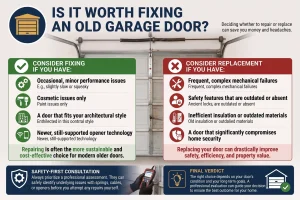
At some point the repair stops making financial sense. We work through that decision in Is It Worth Fixing an Old Garage Door? 7 Questions That Decide It, which covers door age, repeat repairs, and panel matching.
Watch for the “You Need a Whole New Door” Jump
Some age-driven recommendations are legitimate. Some are not. If a technician arrives for one failed part and leaves recommending a full replacement without showing you a structural problem, get a second opinion before signing anything. Clopay publishes a straightforward homeowner’s guide on how to avoid garage door scams that describes this exact pattern.
7. When You Call
Timing is one of the few price factors you sometimes control. Standard business-hours service is the baseline. Evenings, weekends, holidays, and true emergency dispatch all carry a premium, at our company and at every reputable competitor.
The premium is real work, not a surcharge for its own sake. It covers a technician leaving home at eleven at night with a stocked truck. What is worth understanding is when paying it is the right call. A door stuck open overnight leaves your home unsecured. A car trapped inside before an early shift is a genuine problem. A door that will not close because a sensor is dirty can wait until morning, and waiting will save you money.
Our guides on what to expect during an emergency garage door repair call and emergency garage door repair troubleshooting tips help you sort which situation you are in before you dial.
Why Winter Garage Door Repair Calls Cost More
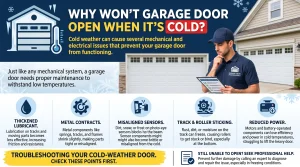
Two reasons stack in January. Cold weather triggers more failures, so demand rises and same-day slots fill. And more of those failures happen at inconvenient hours, because a door that has been marginal all fall gives out on the first morning below zero. The failure modes are specific and mostly predictable, which we cover in Why Won’t My Garage Door Open When It’s Cold? 6 Things That Go Wrong in Winter.
8. Residential Versus Commercial Doors
Commercial door repair costs more than residential across the board, and the gap is not small. Different hardware, higher cycle counts, larger openings, and often a rolling steel or sectional design built for daily volume no residential door ever sees.
A commercial operator is a different class of machine than a homeowner’s opener, with different controls, safety edges, and sometimes fire-door release requirements. Parts cost more and technicians need additional training on the systems.
Downtime is usually the bigger cost. A dock door that will not open stops the business, which is why commercial service tends to be scheduled around urgency rather than convenience. We cover this side of the work on our commercial overhead door page and in our post on commercial overhead door repair in Sussex.
What Makes Commercial Garage Door Repair More Expensive
Cycle count is the short answer. A residential door might run four times a day. A busy commercial door can run forty. Everything on it is built heavier to survive that, and heavier parts cost more to buy and more to install.
9. Service Call Fees, Labor, and What the Warranty Covers
The last variable is what the company includes in the number it quotes you. Two quotes for the same repair can differ substantially based on structure alone.
Ask four things. Is there a diagnostic or trip fee, and is it applied toward the repair if you proceed? Is labor bundled into the part price or billed separately? What warranty covers the part, and for how long? Is labor warranted too, or only the part?
That last one separates companies. A part warranty with no labor warranty means a covered failure still costs you a service call. And a low quote on a spring often means a standard-cycle spring where the door called for high-cycle, which is a price difference you feel again in a few years. Our garage door service page lists what our visits include, and our post on the benefits of choosing professional garage door repairs covers what a licensed technician brings that a handyman rate does not.
Questions to Ask Before You Approve a Garage Door Repair
What failed and why. What is the part, and its rating. What is the total, parts and labor. What is warranted, and for how long. Any technician who will not answer those four in plain language is telling you something.
Which Garage Door Repairs Are Cheap and Which Are Expensive
Repair | Relative cost | What moves it within that range |
Safety sensor alignment | Lowest | Whether it is alignment or a failed sensor or wiring |
Bottom seal and weather stripping | Low | Door width, whether stop molding also needs replacing |
Remote or keypad replacement | Low | Number of units, whether the receiver also failed |
Roller replacement | Low to mid | Steel versus nylon, number of rollers, track damage |
Cable replacement | Mid | Always sold as a pair, door weight |
Torsion spring replacement | Mid | One spring or two, cycle rating, wire gauge, door weight |
Track repair or realignment | Mid | Whether sections are bent or only misaligned |
Panel replacement | Mid to high | Material, color match, whether the series is still made |
Opener replacement | Highest | Drive type, horsepower, battery backup, smart features |
Two notes on using this table. First, an after-hours call moves any row up. Second, if you receive a quote that sits far outside the row for your repair in either direction, ask why before you sign. Unusually low is as much a warning as unusually high, and the industry maintains garage door repair scam awareness resources precisely because bait pricing followed by an on-site revision is a recognized pattern.
The Short Version
The honest answer to what a garage door repair costs is that it depends on the part, and any company that gives you a firm number before seeing the door is guessing. What you can do is arrive at the conversation informed: know roughly where your repair sits in the range, know your door size and rough age, and know the four questions to ask before approving work.
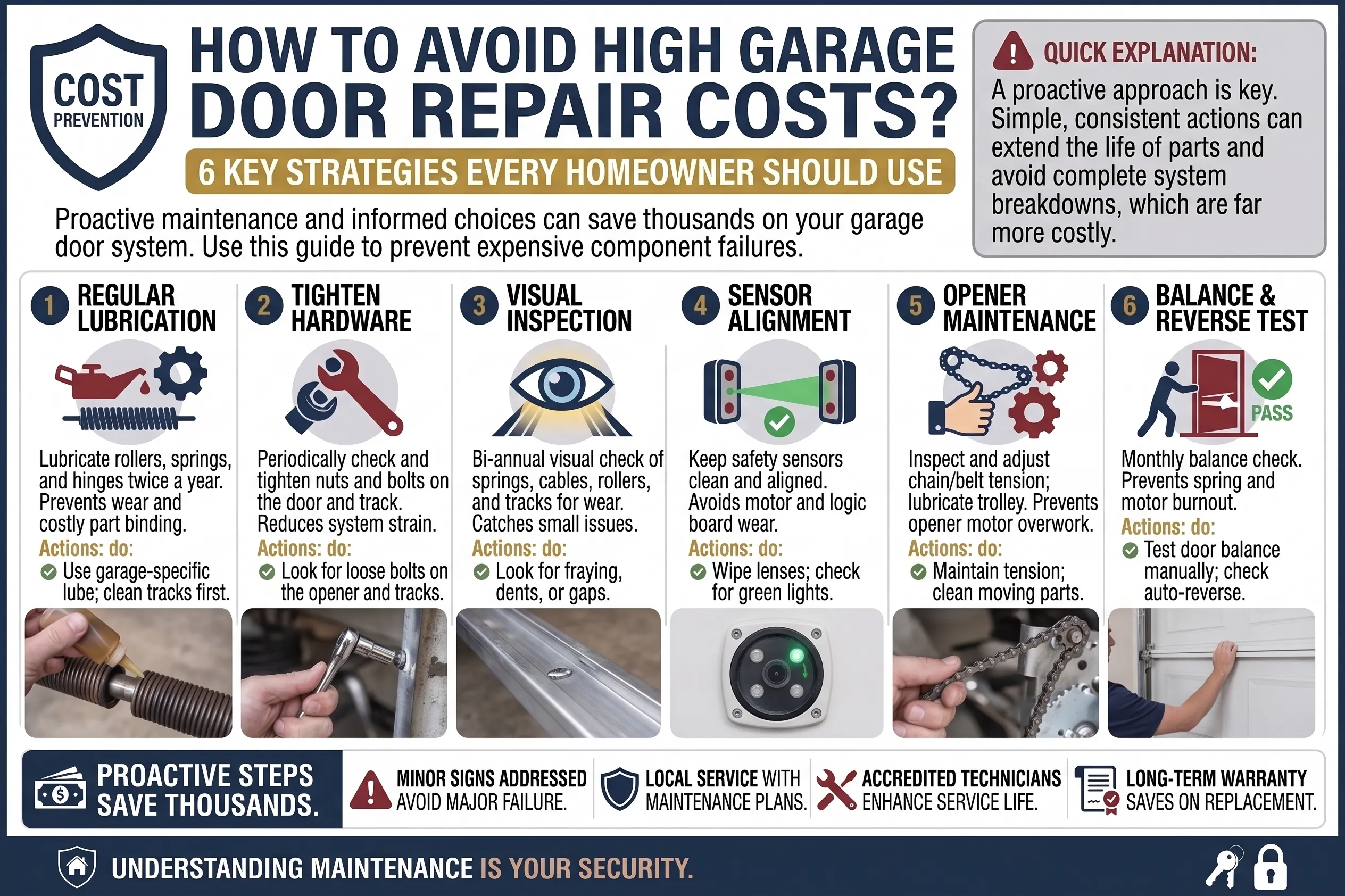
Beyond that, the biggest money mistake homeowners make is not overpaying for a repair. It is deferring a cheap one. A grinding roller is inexpensive. The track damage it causes after six months of grinding is not.
If you want a real number for your door, Anytime Garage Doors serves Sussex and the surrounding Waukesha and Milwaukee communities, and we will give you a straight answer on the phone once we know the symptom, then a firm quote before any work begins. Request a free quote and we will tell you honestly whether it is a repair or a replacement.