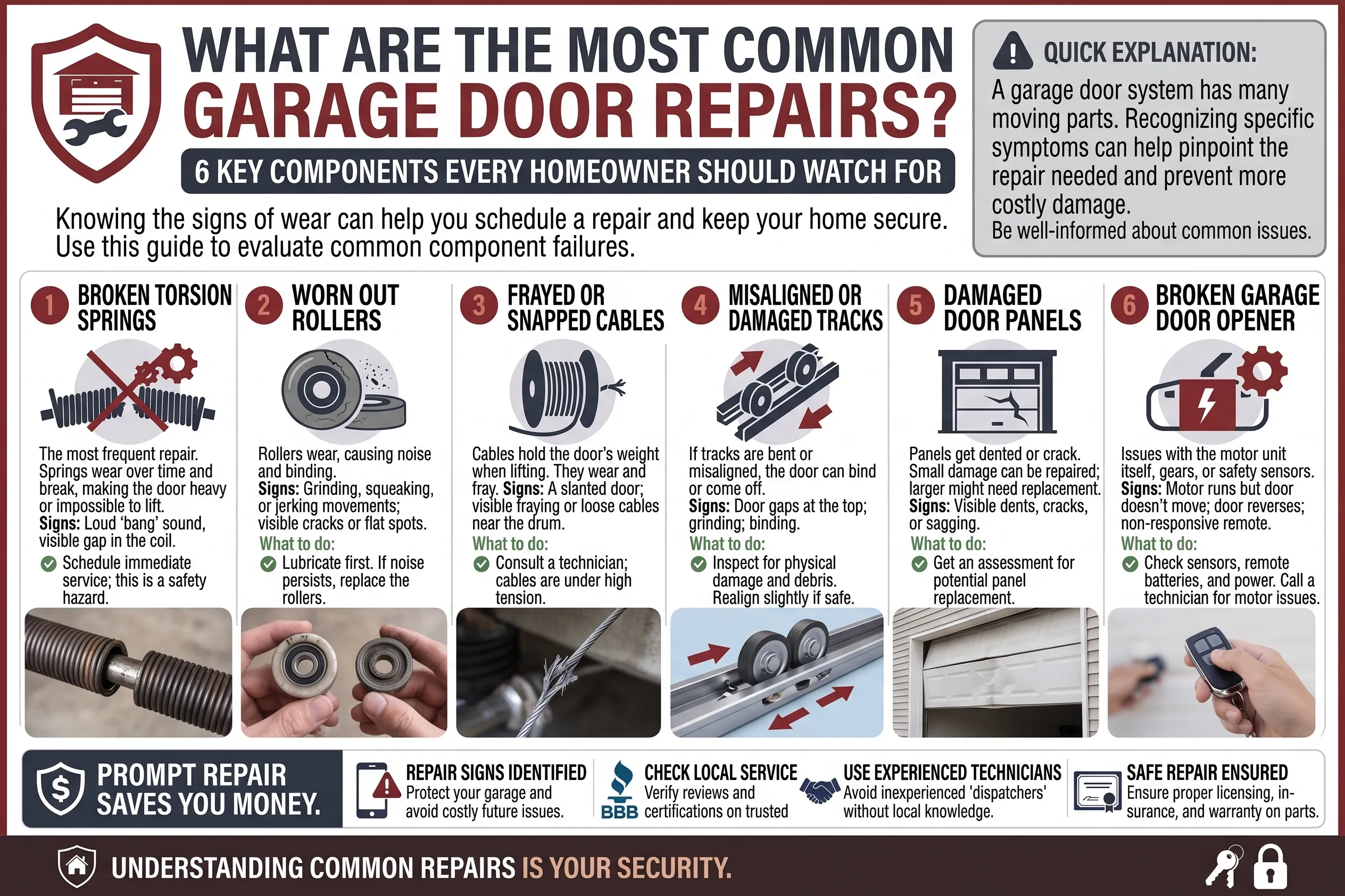
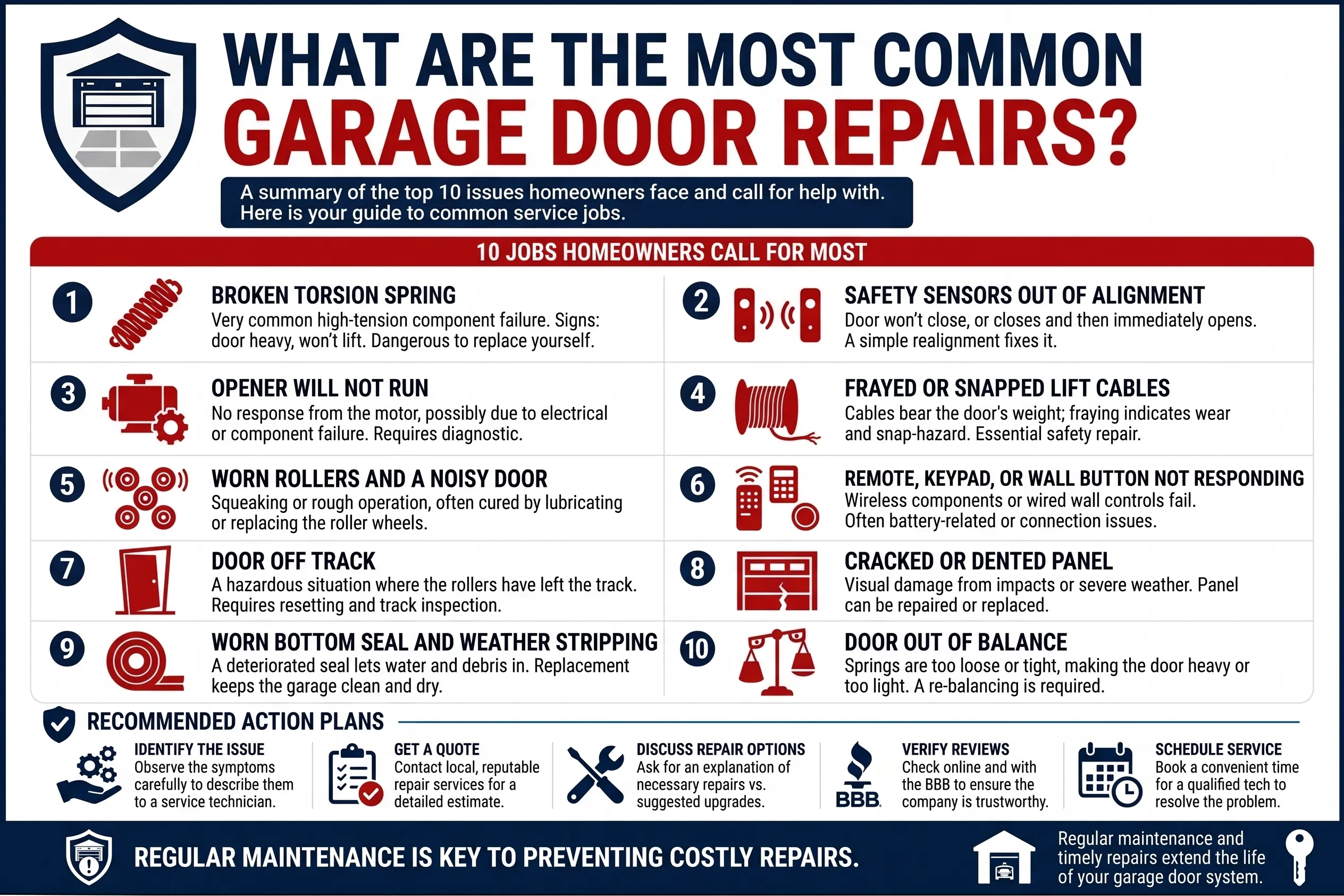
The most common garage door repairs are broken torsion springs, misaligned safety sensors, failed openers, frayed lift cables, worn rollers, dead remotes, doors off track, damaged panels, worn bottom seals, and doors that have drifted out of balance. Springs account for more service calls than anything else, because they carry the entire weight of the door and wear out on a predictable cycle. Most of these repairs are same-day jobs for a trained technician. A few of them, springs and cables in particular, are genuinely dangerous to attempt without the right tools and training.
Key Takeaways
- Broken torsion springs are the single most common repair call, and the one homeowners should never attempt themselves.
- A door that reverses before it closes is almost always a safety sensor problem, not a door problem.
- Springs and cables work in pairs and wear at the same rate, so replacing one and leaving the other usually means a second service call within months.
- Grinding, squealing, and rattling are early warnings. Doors that get noisy are telling you a part is about to fail.
- Roughly half of these repairs are urgent and half can wait a few days. The comparison table below sorts them.
- A door that will not stay put halfway open is out of balance, which puts the opener under strain it was never designed to carry.
1. Broken Torsion Spring
A door that suddenly weighs 200 pounds instead of feeling nearly weightless has a broken spring. This is the most frequent repair call in the trade, and it usually announces itself with a loud bang from the garage, sometimes in the middle of the night.
Most likely cause: Torsion springs are rated in cycles, and a typical residential spring is built for somewhere between seven and ten thousand open-and-close cycles. A household that runs the door four times a day works through that in about five to seven years. Cold weather accelerates it, because steel gets brittle as temperatures drop.
What the repair involves: A technician measures wire gauge, inside diameter, and length, matches a replacement rated for the door’s weight, unwinds the old spring under controlled tension, and rebalances the door afterward. On a two-spring system both get replaced together.
What you can safely check: Look at the spring above the door. If you see a visible gap of an inch or two in the coil, it is broken. That is the extent of the homeowner inspection.
Call a pro if: Always. A wound torsion spring stores enough energy to break bones, and the winding bars are not something to improvise. There is no version of this repair that is safe to attempt without training. Our existing guide on what happens when a broken garage door spring snaps covers why in detail, and the signs of a broken garage door spring are worth knowing before you hit the button.
How to Tell If Your Garage Door Spring Is Broken
The three-second test: pull the red release cord and lift the door by hand. A door with intact springs should feel like lifting twenty pounds and should stay wherever you leave it. A door with a broken spring will feel immovable, or will slam back down the moment you let go. If it slams, step back and leave it down until a technician arrives.
2. Safety Sensors Out of Alignment
A door that starts to close, then reverses and runs back up, has a sensor problem in the overwhelming majority of cases. Often the opener light blinks a set number of times to confirm it.
Most likely cause: The two photo eyes mounted near the floor on each side of the opening have to see each other. A bumped bracket, a cobweb, a leaning rake, road salt film, or even low winter sun hitting the lens at the wrong angle will break the beam. Loose staples in the sensor wiring are a close second.
What the repair involves: A technician checks the indicator LEDs on both units, realigns the brackets, tests the wire run for breaks or staple damage, and confirms the door reverses correctly on an obstruction test.
What you can safely check: Wipe both lenses with a dry cloth and move anything sitting in the beam path.
Call a pro if: The lights stay off or keep flickering after cleaning, or the door still reverses on a clear opening. That points to a wiring fault or a failed sensor rather than an alignment issue. We have written separately on why a garage door sensor turns yellow and on garage door sensor alignment issues, since that one indicator causes more confusion than any other light on the system.
Why Your Garage Door Reverses Before It Closes
Reversal is the safety system working exactly as designed. Federal safety requirements have mandated reversing mechanisms on residential openers since 1993, so an opener that refuses to close is protecting someone, even when there is nothing visibly in the way. Never bypass or tape over the sensors to force the door shut. If you want to understand how seriously the industry treats this, the International Door Association has built much of its safety education around this exact mechanism.
3. Opener Will Not Run
When the motor is silent, hums without moving, or runs while the door stays put, the opener itself needs attention. This covers a wide range of faults, from a dead capacitor to a stripped drive gear to a failed logic board.
Most likely cause: On chain-drive units past the ten-year mark, a stripped plastic drive gear is the usual finding. A motor that hums but does not turn generally points to a failed capacitor. A completely dead unit is often power, either a tripped GFCI outlet or a surge that took out the board.
What the repair involves: The technician isolates whether the fault is electrical, mechanical, or logic, then either rebuilds the drive assembly or recommends replacement. On units older than fifteen years, replacement is usually the better value, and modern garage door opener models bring battery backup and rolling-code security that older units cannot match.
What you can safely check: Confirm the outlet has power and that the door is not locked or disengaged from the trolley.
Call a pro if: The motor hums, grinds, or trips the breaker. Those are internal faults. Our LiftMaster garage door opener troubleshooting guide walks through the diagnostic light codes for that brand specifically.
How Much a Garage Door Opener Repair Costs
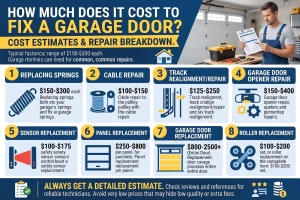
Opener work spans a wide range, from a low-cost gear kit to a full replacement with installation, and the deciding factors are the age of the unit, the drive type, and whether the logic board is involved. We break the whole picture down in How Much Does It Cost to Fix a Garage Door? 9 Things That Change the Price, including why the same symptom can produce two very different quotes.
4. Frayed or Snapped Lift Cables
A door that hangs crooked, one side high and one side low, has a cable problem. You may also see a cable dangling loose along the track.
Most likely cause: Cables run over drums at the top of each side and take constant abrasion. Moisture and road salt accelerate corrosion, and a door that has been running out of balance chews through them faster. When one cable frays, the other is almost always close behind.
What the repair involves: The technician secures the door, releases spring tension, replaces both cables as a set, reseats them on the drums, and rebalances. Cables and springs are inspected together, since a cable failure often reveals a spring nearing the end of its life.
What you can safely check: Nothing beyond a visual look from a safe distance. Do not touch a slack cable.
Call a pro if: Always, for the same reason as springs. The cables are what hold the door against spring tension. We cover why garage door cables need to be replaced in pairs and what happens if you do not replace garage door cables in more depth.
Why a Garage Door Cable Snaps on One Side First
Cables rarely fail simultaneously. One side takes slightly more load because of how the door was originally balanced, and that side wears first. This is exactly why replacing a single cable is false economy. The second one is running on the same mileage.
5. Worn Rollers and a Noisy Door
Grinding, squealing, or a rattle that shakes the whole garage usually traces to worn rollers, dry hinges, or failing bearings. Noise is the earliest and cheapest warning the system gives you.
Most likely cause: Builder-grade steel rollers with exposed bearings wear out in roughly seven to ten years. Once the bearing seizes, the roller drags along the track instead of rolling, which chews the track and loads the opener.
What the repair involves: Replacement of all ten to twelve rollers, inspection of hinges and track brackets, and lubrication of the bearing plates. Nylon rollers are the standard upgrade and cut noise substantially.
What you can safely check: Watch the door run and listen for where the noise originates.
Call a pro if: The noise is metallic grinding rather than a squeak, or the door shudders as it moves. That indicates a roller has already seized. We have covered what causes garage door squeaking over time and rounded up the best garage door rollers for homeowners weighing an upgrade.
How to Fix a Garage Door That Grinds When It Opens
Grinding is mechanical contact where there should be rolling motion. It will not resolve on its own and it does not respond to lubricant for long. Waiting on it typically turns a straightforward roller job into a track repair, because a seized roller scores the track every cycle.
6. Remote, Keypad, or Wall Button Not Responding
When one control works and another does not, the problem is the control. When nothing works, the problem is the opener. That single distinction resolves most of these calls before a technician arrives.
Most likely cause: Dead remote batteries lead the list, especially after a cold snap. Beyond that: lost programming after a power event, a keypad with moisture in the housing, or radio interference from LED shop lights, which is a genuinely common and badly underdiagnosed cause of short remote range.
What the repair involves: Reprogramming the controls to the opener, replacing failed units, and where range is the complaint, checking the antenna wire and identifying interference sources.
What you can safely check: Swap the remote battery and test the wall button.
Call a pro if: The wall button works and no remote does after fresh batteries and reprogramming, which points to the receiver. Our guides on replacing a garage door opener battery and programming a LiftMaster garage door opener cover the routine cases.
Why Your Garage Door Remote Only Works Up Close
Shrinking range is a symptom, not a quirk. It usually means the antenna wire hanging from the opener has been tucked up or cut, or that something in the garage is broadcasting interference on the same band. A remote that used to work from the end of the driveway and now works from ten feet away is worth reporting.
7. Door Off Track
A door sitting crooked in the opening, jammed partway, or visibly out of its track needs to come down immediately. Stop using the opener.
Most likely cause: Impact from a vehicle is the most common. After that: a broken cable letting one side drop, a seized roller jumping the track, or a bent track section from something stored against it.
What the repair involves: The technician supports the door, releases tension, reseats the rollers, straightens or replaces damaged track sections, checks the door for panel and hinge damage, and rebalances before returning it to service.
What you can safely check: Whether the car is clear and the door is stable. Nothing else.
Call a pro if: Always, and quickly. An off-track door can drop. We have written on how to fix a garage door off track and how to get a garage door wheel back on track for the mechanics of what is involved.
What to Do When Your Garage Door Comes Off Track
Leave it where it is. Do not run the opener to try to correct it, which is the instinct and which almost always makes the damage worse by bending more track and pulling hinges. If the door is stuck up and the car is underneath, that is an emergency garage door repair call rather than something to schedule next week.
8. Cracked or Dented Panel
A single damaged panel is usually replaceable without replacing the door, provided the model is still in production and the door is structurally sound. Backing into the door is how most of these start.
Most likely cause: Vehicle impact, hail, or long-term rust starting at the bottom section where moisture and salt collect.
What the repair involves: Matching the panel to the manufacturer, series, and color, which is straightforward on a door under about ten years old and progressively harder past that. The technician also checks for hidden hinge and strut damage, since impact energy travels.
What you can safely check: Whether the door still runs smoothly and whether the damage extends to the hinges or struts.
Call a pro if: The door binds, the damage crosses more than one section, or the bottom section is rusted through. Our guide on changing a garage door panel explains the process, and it is worth reading alongside our overview of residential garage door service options.
When a Damaged Garage Door Panel Means Replacing the Whole Door
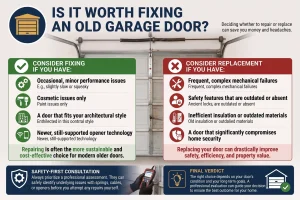
Panel matching is the deciding factor more often than the damage itself. Once a series is discontinued, the choice narrows to a mismatched panel or a new door. Age, repeat repairs, and insulation performance all feed into that call, and we work through the full decision in Is It Worth Fixing an Old Garage Door? 7 Questions That Decide It.
9. Worn Bottom Seal and Weather Stripping
Daylight under a closed door, water on the garage floor, or a door that freezes to the slab means the bottom seal has failed. It is the least dramatic repair on this list and one of the most consequential for an attached garage in Wisconsin.
Most likely cause: Rubber hardens and cracks with UV exposure and freeze-thaw cycling. Five to seven years is a realistic service life here. Salt exposure shortens it.
What the repair involves: Replacing the astragal in the bottom retainer, and where needed, the perimeter stop molding. The technician also checks that the door is closing level, because an uneven gap usually means the door is out of adjustment rather than the seal being worn.
What you can safely check: Close the door and look for daylight across the bottom.
Call a pro if: The gap is uneven side to side, which is an adjustment problem, or the retainer itself is bent. We have covered installing garage door weather stripping separately.
Why a Failed Bottom Seal Gets Worse in Winter
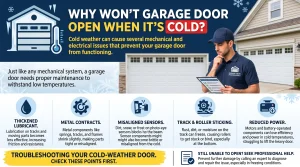
A hardened seal lets meltwater under the door, where it refreezes and bonds the door to the slab. The opener then tries to lift a door that is physically stuck, which is how a fifteen-dollar strip of rubber turns into a stripped drive gear. Winter has several failure modes like this, and we work through them in Why Won’t My Garage Door Open When It’s Cold? 6 Things That Go Wrong in Winter.
10. Door Out of Balance
A door that will not stay put when you stop it halfway is out of balance, and it is quietly shortening the life of everything else on this list. Most homeowners never call about this directly. It gets found during service for something else.
Most likely cause: Spring tension drifting as the springs age, an added insulation kit or new window inserts changing the door’s weight, or a previous repair where the spring was not matched to the actual door weight.
What the repair involves: Disconnecting the opener, weighing the door’s behavior at several positions, adjusting spring tension, and resetting the opener’s travel and force limits afterward.
What you can safely check: Pull the release cord with the door closed, raise it to waist height, and let go. It should hold position.
Call a pro if: It drifts up or falls. Adjusting tension means working with a wound spring. Our post on how regular maintenance extends the life of garage doors explains why balance checks belong on an annual schedule, and the same principle applies to a commercial overhead door, where cycle counts are far higher and imbalance shows up much faster.
How to Tell If Your Garage Door Is Out of Balance
The manual lift test above is the whole diagnostic. A balanced door feels light and stays where you leave it at any height. If yours drops or climbs, the springs are no longer carrying the load and the opener motor is making up the difference every single cycle.
Which Garage Door Repairs Are Urgent and Which Can Wait
Repair | Urgency | Why |
Broken torsion spring | Call now | Door is unusable and unsafe to lift manually |
Door off track | Call now | Door can drop; damage worsens with every attempt |
Snapped or frayed cable | Call now | The door is no longer safely restrained |
Door stuck open | Call now | Home is unsecured, especially overnight |
Opener dead with car inside | Call now | Access issue; manual release may be needed |
Sensors misaligned | Within a few days | Door will not close but nothing is failing |
Grinding or seized roller | Within a few days | Cheap now, track damage if ignored |
Remote or keypad failure | Can wait | Inconvenience, no mechanical risk |
Worn bottom seal | Can wait, before winter | Energy and water loss, freeze risk later |
Door out of balance | Schedule it | No immediate failure, ongoing wear on everything |
A useful rule when you get a quote: any of the “call now” items should come with a clear explanation of what failed and why. If a technician arrives for a sensor alignment and leaves recommending a full door replacement, get a second opinion. The industry’s own garage door repair scam awareness resources exist because that pattern is common enough to warrant them, and Clopay publishes a practical homeowner’s guide on how to avoid garage door scams that is worth five minutes before you book anyone.
The Short Version
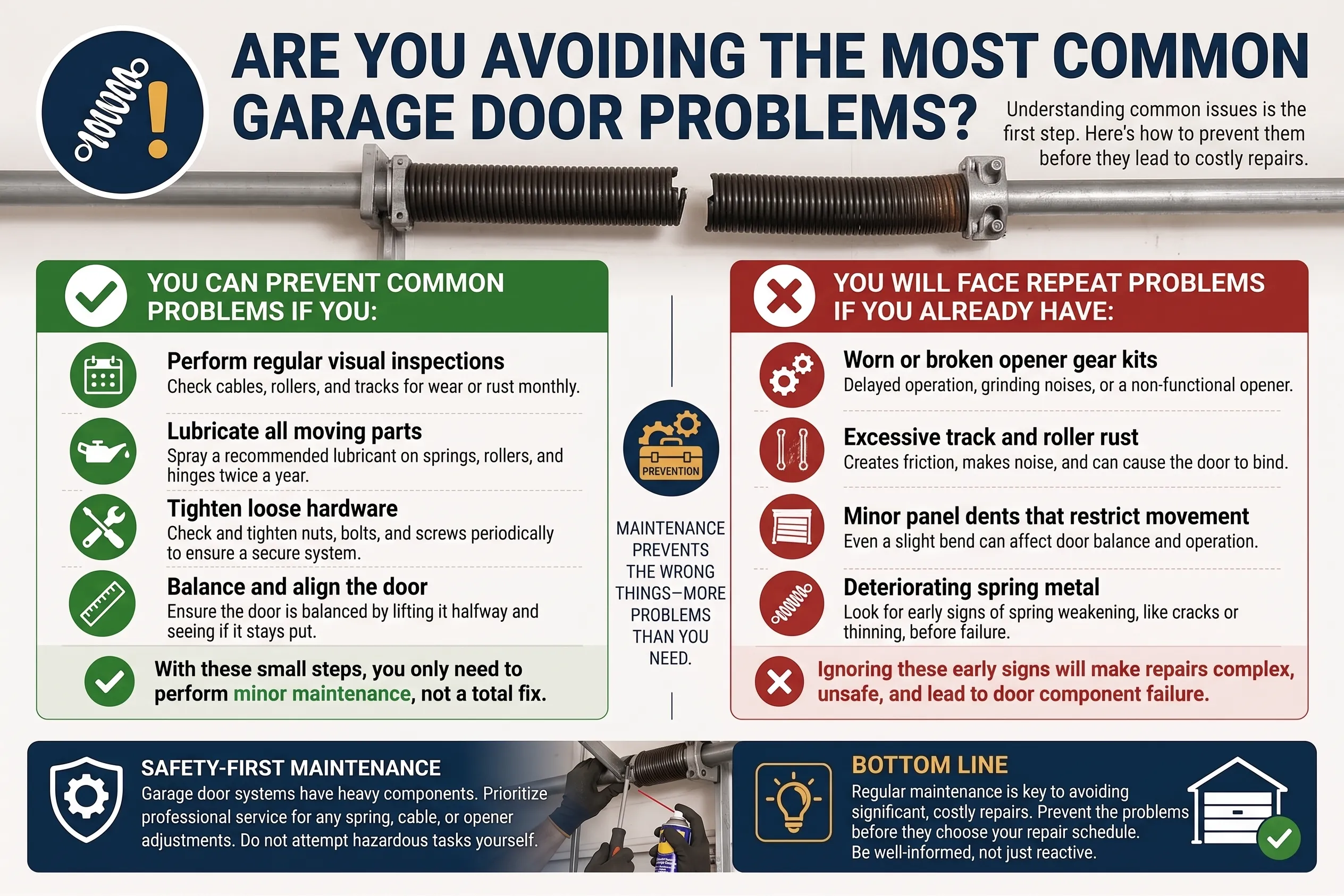
Most garage door problems fall into a small number of predictable categories, and most of them give warning before they fail outright. Doors get noisy before rollers seize. Springs reach a cycle count. Seals harden and crack on a schedule you can almost set a calendar by. The homeowners who avoid emergency calls are generally the ones who acted on the noise.
The dividing line worth remembering is tension. Sensors, seals, remotes, and lubrication are ordinary maintenance. Springs and cables store enough energy to cause serious injury, and no amount of online instruction changes that.
If your door is doing something on this list, Anytime Garage Doors has been handling these repairs across Sussex and the surrounding Waukesha and Milwaukee communities for years, and most of them are same-day work. Schedule your garage door repair or ask about our full garage door service options, and we will tell you honestly whether it is a repair or a replacement before any work starts.